Special Products
Connections:
Statistics:
- Term1
- Statement5
- Important2
- Problem28
- Updated
Special Products
Formulas that let you quickly “unpack” compact powered expressions into expansions or, going the other way, “pack” long sums into a compact form. These formulas save you from doing routine calculations by hand.
Plus-minus sign
Do not memorize 4 separate formulas: the square of a sum, the square of a difference, the cube of a sum, and the cube of a difference. It is enough to remember 2 formulas if you use the plus-minus sign, because nothing changes except the signs:
In sums, all signs are always pluses. In a difference, the minus sign always comes right after the first term in the expansion. In the cube case, it also appears in front of the last term.
The difference of squares stands apart
Formulas whose names start with the degree, like square and cube, have a similar shape, and they can be derived naturally by expanding brackets
But the difference of squares stands apart. First, it factors into brackets with a plus and a minus. Second, from the form you cannot naturally and explicitly get the product (a + b)(a – b) from the difference itself.
The degree matches the coefficient
In the square or cube of a sum/difference, the degree (second or third) also appears as a coefficient in the expansion. For the square it is 2, and for the cube it is 3:
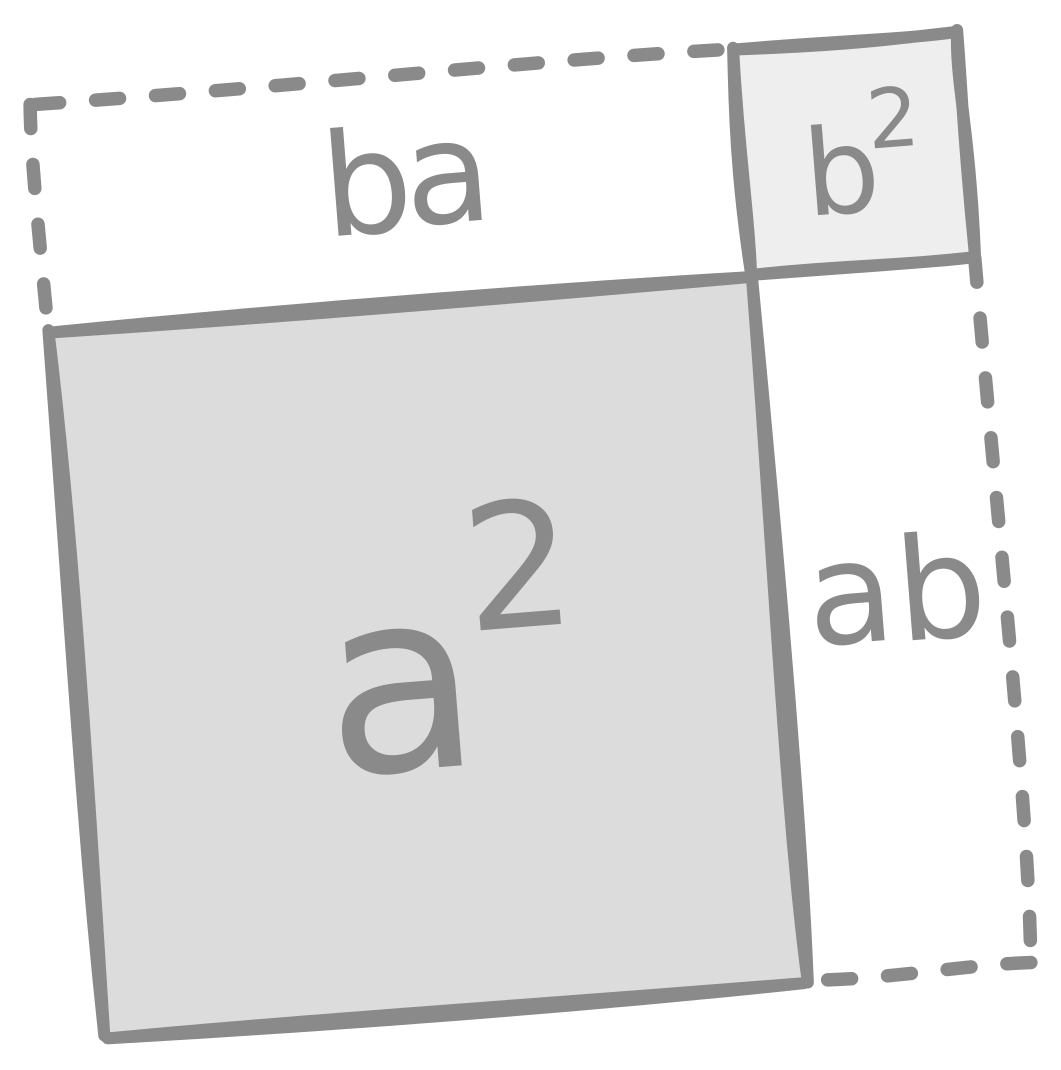
The coefficient is also easy to remember from the geometric derivation. For the square formulas, we build a square, and in the process two rectangles appear. For the cube formulas, we build a cube, and in the process two kinds of three parallelepipeds appear.