Summary

Quadratic formula

A clear derivation of the quadratic formula with a detailed explanation of every step. Learn what the discriminant is, where it comes from, and how it tells you how many roots a quadratic equation has.

Connections:

The quadratic formula is derived by completing the square, so you really need to know how that works!

Statistics:

  • Term2
  • Statement1
  • Important2
  • Problem14
  • Updated

General root formulas

General formulas for solutions (roots) let you basically not solve the equation step by step. You just substitute the coefficients and get the roots directly! This is especially useful for harder equations like quadratics, where the usual method takes a whole chain of steps.

How to solve any quadratic equation

A direct derivation of the quadratic formula via completing the square. If you want a more detailed explanation, the article walks through every step.
ActionEquation
1Write it in the general form.Ax2+Bx+C=0\displaystyle Ax^2 + Bx + C = 0
2Divide both sides by A.x2+BAx+CA=0\displaystyle x^2 + \frac{B}{A}x + \frac{C}{A} = 0
3Move the constant term to the right.x2+BAx=CA\displaystyle x^2 + \frac{B}{A}x = -\frac{C}{A}
4Add and compensate the 2 needed for completing the square.x2+2xBA12=CA\displaystyle x^2 + \yellow{2} \cdot x \frac{B}{A} \cdot \yellow{\frac{1}{2}} = -\frac{C}{A}
5Add and compensate b2b^2 to complete the square.x2+2xB2A+(B2A)2a2+2ab+b2=(a+b)2(B2A)2=CA\displaystyle \underbrace{x^2 + 2\cdot x \cdot \frac{B}{2A} + \yellow{\left( \frac{B}{2A} \right)^2}}_{\small a^2 + 2ab + b^2 = (a+b)^2} - \yellow{\left( \frac{B}{2A} \right)^2} = -\frac{C}{A}
6Complete the square on the left.(x+B2A)2=CA+(B2A)2\displaystyle \left( x + \frac{B}{2A} \right)^2 = -\frac{C}{A} + \left( \frac{B}{2A} \right)^2
7Put the right-hand side over a common denominator.(x+B2A)2=B24AC4A2\displaystyle \left( x + \frac{B}{2A} \right)^2 = \frac{B^2 - 4AC}{4A^2}
8Introduce the discriminant.(x+B2A)2=D4A2\displaystyle \left( x + \frac{B}{2A} \right)^2 = \frac{\brand{D}}{4A^2}
9Take the square root of both sides (if D0D \ge 0).x1,2+B2A=±D2A\displaystyle x_{1,2} + \frac{B}{2A} = \pm \frac{\sqrt{D}}{2A}
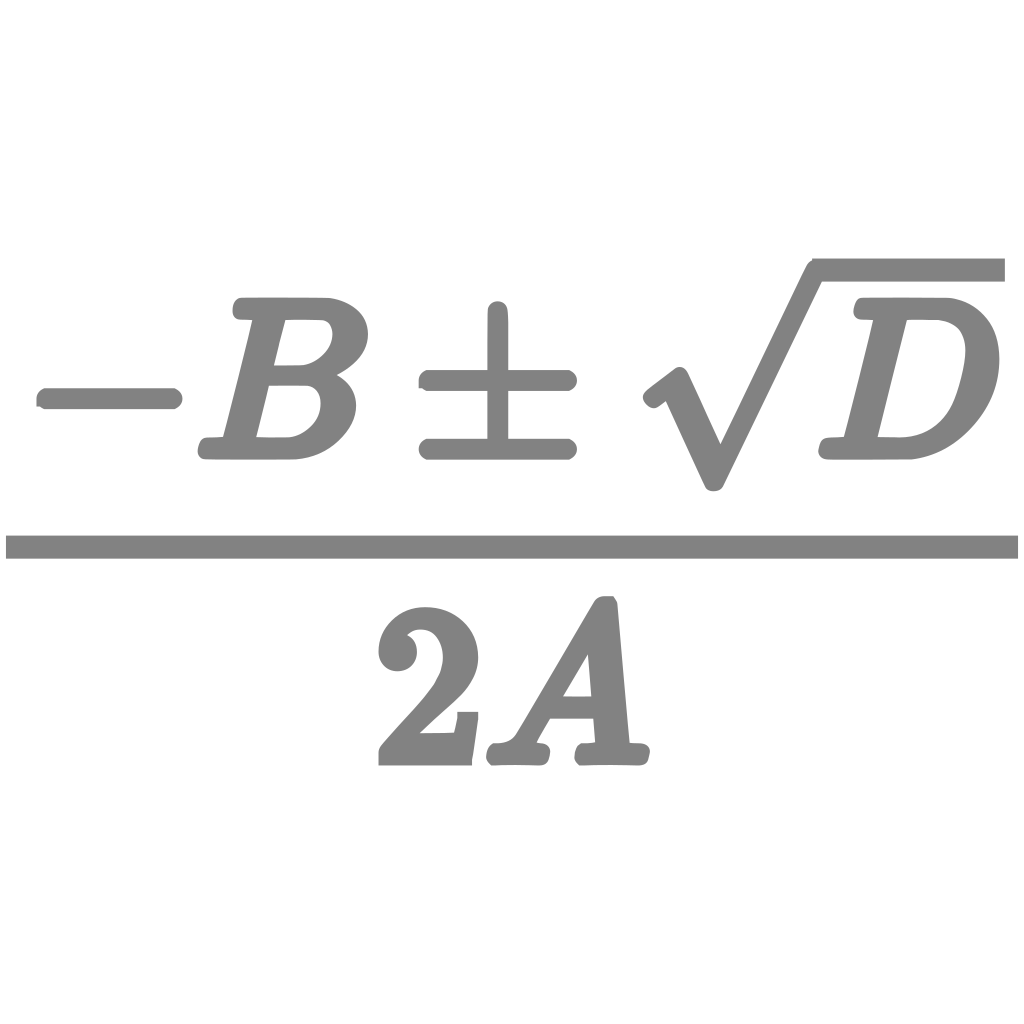
10Isolate x and get the final formula.x1,2=B±D2A\displaystyle x_{1,2} = \frac{-B \pm \sqrt{D}}{2A}

Discriminant

The number D, computed from the coefficients of a quadratic equation in the general form Ax2+Bx+C=0Ax^2 + Bx + C = 0 by the formula:
D=B24ACD = B^2 - 4AC
From the discriminant you can tell in advance (without fully solving the equation) whether it has roots. If the discriminant is negative D < 0, then the equation has no roots.
The discriminant is used directly in the quadratic formula.

The quadratic formula

For any quadratic equation in the general form:
Ax2+Bx+C=0,A0Ax^2 + Bx + C = 0, \quad A \neq 0
You can compute a special number, the discriminant D, by the formula:
D=B24ACD = B^2 - 4AC
The discriminant tells you how many roots the quadratic equation has:
  • D < 0 — the quadratic equation has no roots
  • D = 0 — the quadratic equation has one root
  • D > 0 — the quadratic equation has two distinct roots
  • The roots of the quadratic equation are found by the formula:
    x=B±D2A\boxed{x = \frac{-B \pm \sqrt{D}}{2A}}

    Examples: solving quadratic equations

    👀
    Example
    Solve the quadratic equation using the quadratic formula.
    x22x8=0x^2 - 2x - 8 = 0

    Biquadratic equation

    A special type of fourth-degree equation that can be written in the general form:
    Ax4+Bx2+C=0,A0Ax^4 + Bx^2 + C = 0, \quad A \neq 0
    Examples:
    x4+16x2+55=0x^4 + 16x^2 + 55 = 0
    12y23y4=1 \frac{1}{2}y^2 - \sqrt{3}y^4 = 1
    5=z(z323z) 5 = z(z^3 - 2\sqrt{3}z)
    Such equations can have up to four roots, and they are very easy to solve by reducing them to a quadratic via the substitution t=x2t = x^2:
    At2+Bt+C=0At^2 + Bt + C = 0

    Examples: solving biquadratic equations

    😀
    Elementary
    Solve the biquadratic equation:
    2x43x2+1=02x^4 - 3x^2 + 1 = 0
    Quadratic formula