Factoring quadratics
Connections:
Statistics:
- Statement1
- Important2
- Problem12
- Updated
Possible factorization cases for a quadratic trinomial
Why factor at all?
1
You can simplify expressions
Writing a quadratic trinomial as a product of factors often lets you simplify complicated expressions:
2
Getting back to the sum is easy
Once a quadratic trinomial is factored, getting the sum form back is just a matter of expanding the brackets:
But going the other way, from the sum form to factors, is much harder!
3
The roots become visible immediately
Writing a quadratic trinomial as a product of factors lets you immediately see the roots of its “equation.” In that form it falls under the Zero product property — you just set each factor equal to zero separately and get a true equality 0 = 0:
In factor form, the roots are the numbers next to x, but with the opposite sign!
4
It’s a way to solve quadratic equations
Factoring is one more way to solve quadratic equations, alongside the methods you already know: completing the square and the general root formula. We rewrite the quadratic trinomial as multiplication and immediately see the roots if that expression were a quadratic equation. A big plus is that for simple quadratics, this lets you find the roots fast, sometimes right in your head!
Factoring by hand
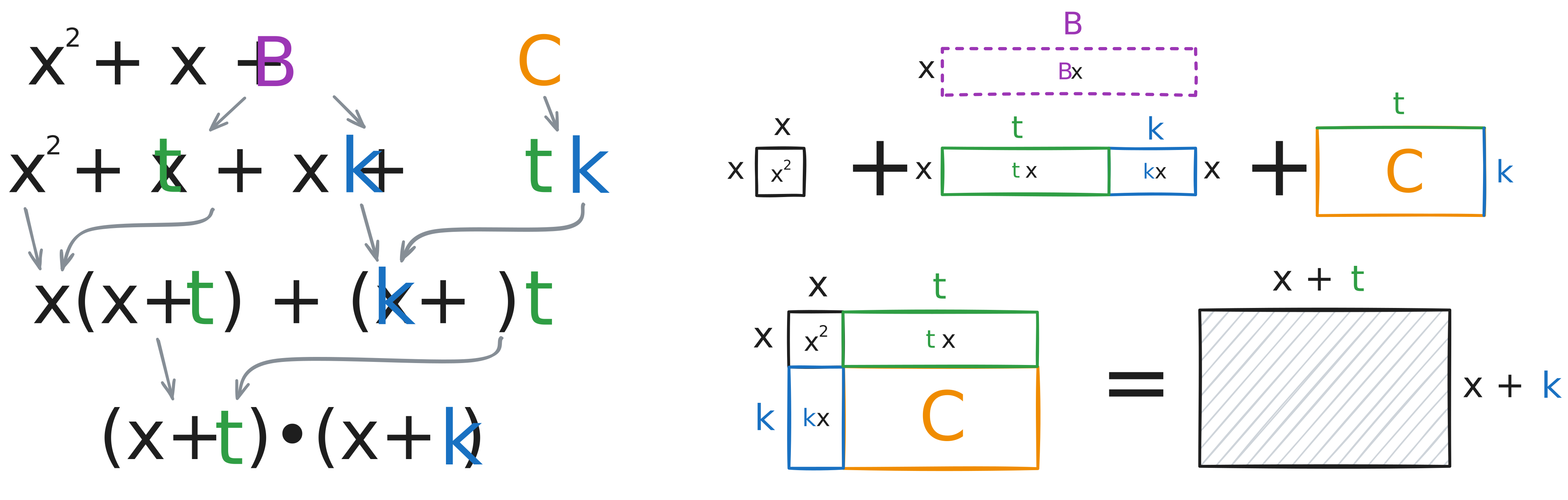
Simple quadratic trinomials can sometimes be factored by hand. To do that, you rewrite coefficient B as the sum of two numbers, and coefficient C as the product of those exact same two numbers. Geometrically, that means you take a few smaller shapes and assemble one big rectangle out of them.
Examples of hand factoring
👀
Example
Factor the quadratic trinomial and find the roots of the corresponding quadratic equation:
Factoring in the general case
Here is the direct derivation of the general factoring formula using completing the square and the difference of squares formula. If you want the full blow-by-blow version, the article breaks down every step in detail.
Factoring a quadratic trinomial
If a quadratic trinomial has roots (let’s call them and ), then that trinomial can always be factored:
These are two different notations, one through addition and one through multiplication, but they mean the same thing, just like 10 + 6 and denote the same number. You can switch a quadratic trinomial into factor form and back again in absolutely any situation!
Examples of factoring through roots
👀
Example
Factor the quadratic trinomial by solving the corresponding quadratic equation:
Any two numbers can be roots!
The mere fact that the formula exists means that for any two numbers there are infinitely many quadratic trinomials whose roots are exactly those numbers!
Take the numbers 5 and –2. Plug them in for and in the factorization formula, and by choosing any values you want for A, you can write down as many quadratic trinomials as you like: