
Quadratic Equations in Real Life
Additional
Connections:
Statistics:
- Problem25
- Updated
All uses, applications, and benefits of quadratic equations in “real life” can be roughly split into two types:
1
Puzzles — you take a real situation and real data, then deliberately cook up the conditions and questions so the answer comes from solving a quadratic equation. In other words, if you were naturally solving that real problem, you would not end up at a quadratic equation. That will probably annoy you, but most so-called real-life quadratic problems are exactly this kind of specially rigged puzzle stuffed into a “real-world” wrapper.
2
Real problems — no caveats, no cheating. These are genuine situations that are directly described by quadratic equations. You actually can arrive at those equations naturally while solving a real task. There are far fewer examples like that, but they do exist, and we will look at them here too, so relax.
So why the hell do we even need these “puzzles” if they have no practical use? They do have a use, just mostly for you personally — they are solid, varied training for your ability to turn text and sneaky conditions into formulas. And overall, even these puzzles show that quadratic equations are not some detached nonsense floating away from reality. They do show up in real situations, just usually only if the conditions are chosen cunningly.
Household Problems
Quadratic equations hide in daily life damn near everywhere: cardboard boxes, walkways, shopping trips, and so on… Yeah, most of these problems are still “puzzles”. But there are also some nice exceptions — situations from actual life that naturally reduce to quadratic equations.
What’s in the Box?!
😀
Elementary
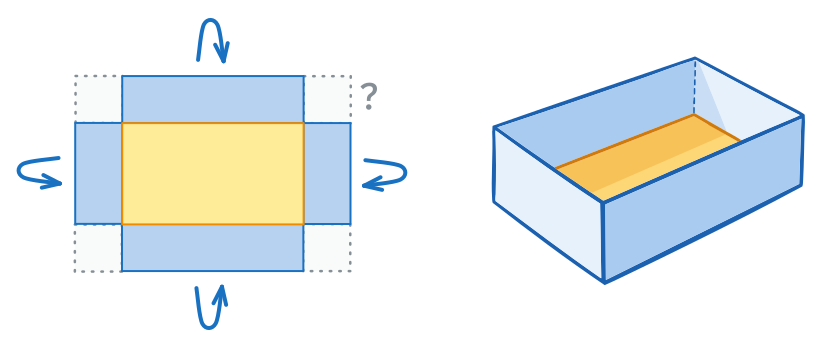
A sheet of cardboard measuring 40 cm by 30 cm is used to make a box whose base area must be 936 square centimeters. To do that, identical square pieces are cut from each corner. Find the side length of each cut-out square.
Standard Frames
😀
Elementary
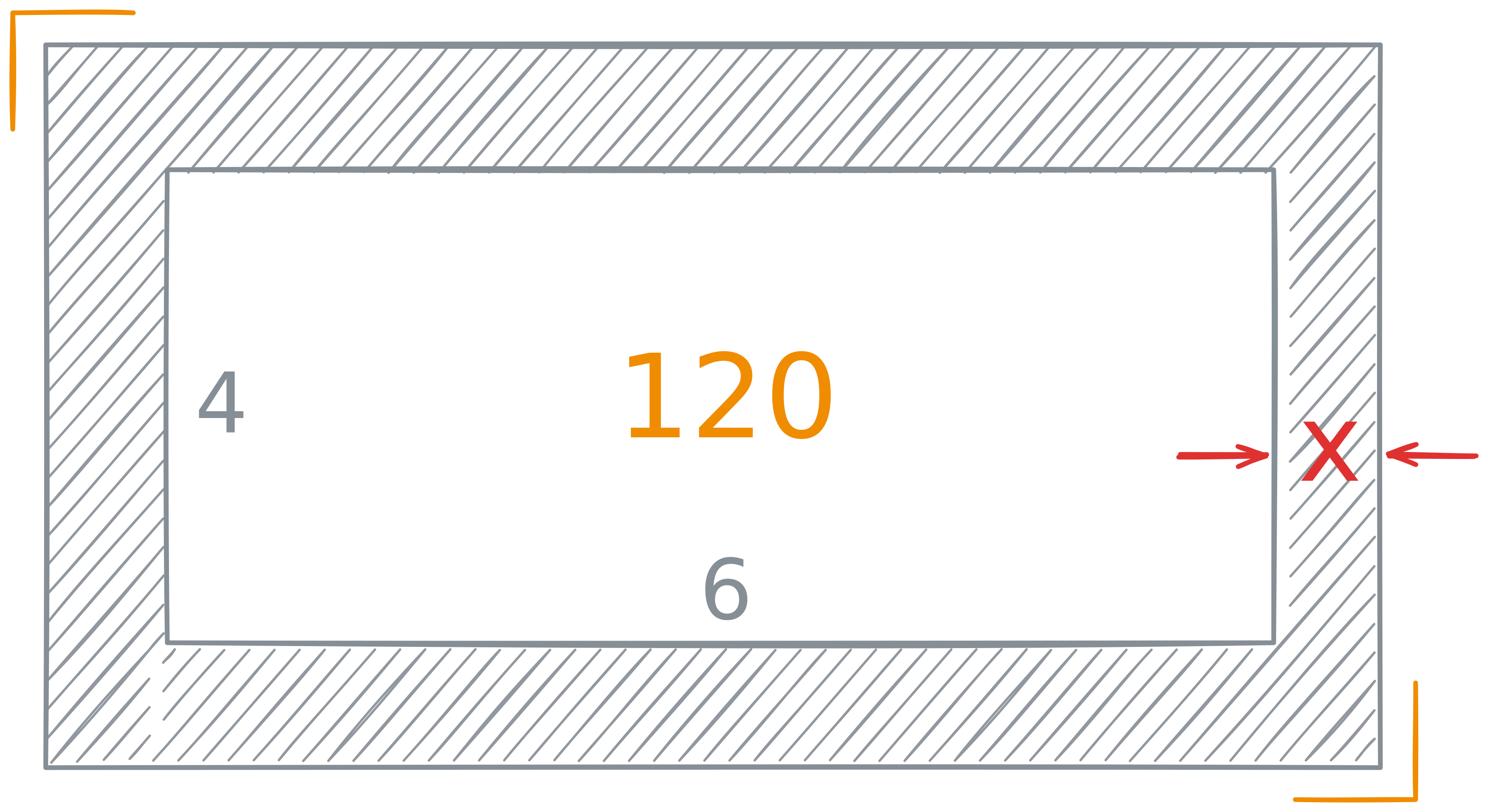
After doomscrolling the news and catching the trend, you decide to launch a new business making sturdy steel frames. To reduce the weight and price, you decide the frame cross-section area should be 120 square centimeters. The inner dimensions of the frame are 4 cm in height and 6 cm in width. How thick should the frame be?
A View to Remember
😀
Elementary
A city square plans to install a large rectangular airplane model measuring 8 by 12 meters. Around it, workers need to lay a walkway of paving stones with the same width everywhere so lots of people can admire the thing at once. The total area of the installation together with the walkway must be twice the area of the model itself. Find the width of the walkway.
Age Problems…
🤯
Advanced
Six years ago, Paul’s age was equal to twice the square of Anna’s age. In four years, Anna’s age will be one fourth of Paul’s age. How old are Paul and Anna now?
The Perfectionist’s Garden
🤯
Advanced
In a city park there is a large rectangular flower bed measuring 10 meters by 15 meters. The park owner, being a perfectionist, wants to plant 36 flowers on this bed so that the equal spacing between the flowers along the longer side is 1 meter greater than along the shorter side. Find the spacing between the flowers along each side.
Physics
A lot of people hate physics, and that is a shame. Physics gives you one of the biggest piles of examples of situations and problems that reduce to quadratic equations. And you get both kinds here: genuinely real problems and the usual cleverly staged “puzzles”.
Motion with Acceleration
When forces act on objects, their speed changes: a soccer ball kicked by a foot, a snowball thrown by hand, a bow string launching an arrow, or Earth’s gravity speeding up a hammer falling downward. This change in speed can be measured. “The speed at which speed changes” sounds weird, but that quantity is called acceleration and is denoted by the letter a.
The good news is that simple types of accelerated motion are described directly by quadratic equations. No tricky setup is needed at all. The classic example is free fall under Earth’s gravity. Our planet gives any object an extra acceleration of g = 10 meters per second for every second it stays in the air. If an object is dropped from height with initial speed , then its height h at time t is given by:
The sign in front of depends on the direction of the initial velocity. If the object starts downward, you use a minus. If it starts upward, you use a plus.
Throwing Balls from the Leaning Tower of Pisa
😀
Elementary
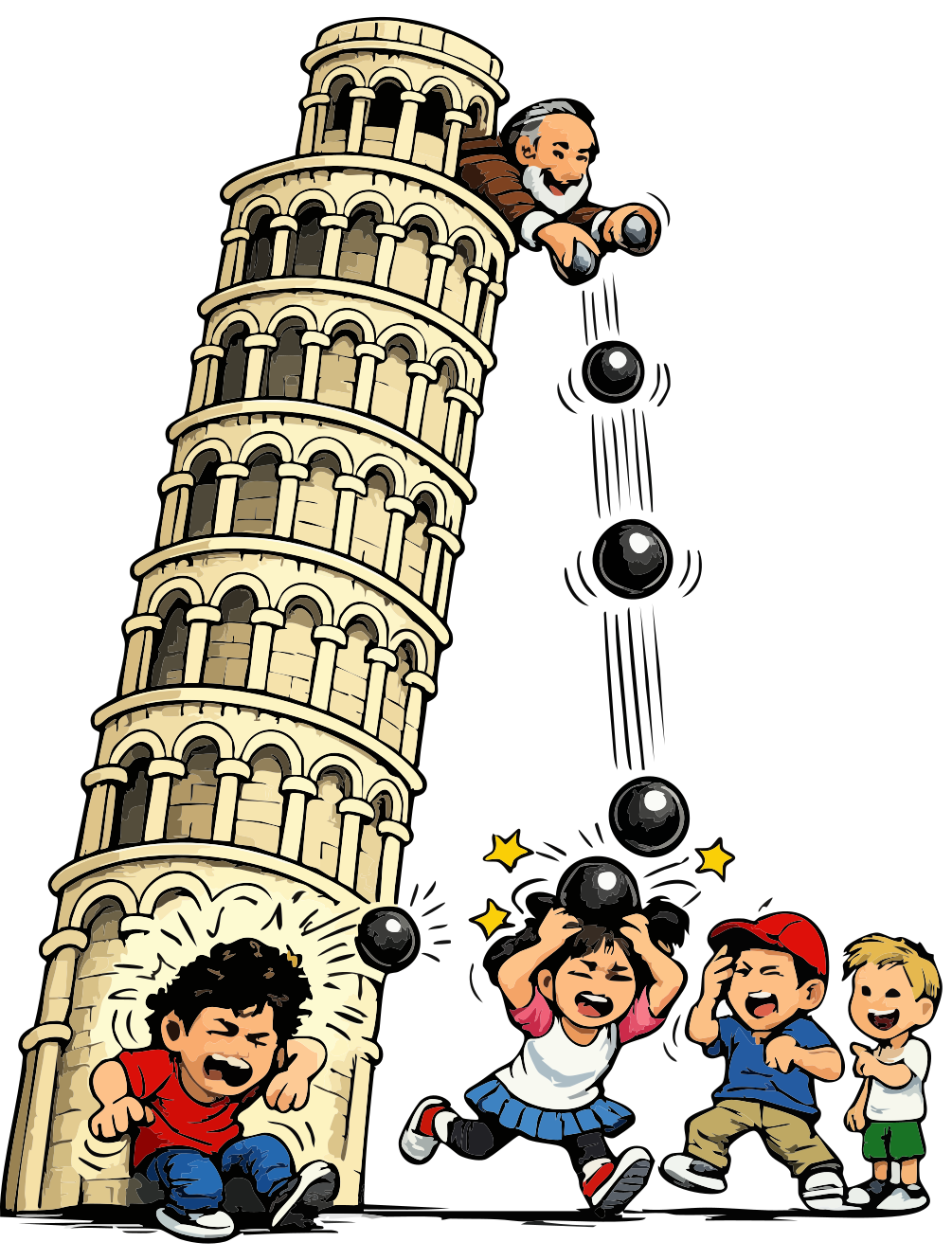
Sneaky Galileo climbed the Leaning Tower of Pisa, 60 meters high, to chuck some balls off it. He does not just drop them — he throws them at 5 m/s. He throws the first ball downward and the second upward. After how many seconds does each one hit the ground?
Electricity
Quadratic equations have also crawled into electric circuits. Circuit elements can be connected in series or in parallel, which lets you flexibly control voltage, current, and resistance. For parallel connections, the total resistance is calculated from the individual resistances , , and so on by the lovely ugly formula:
Fixing a Heater
😀
Elementary
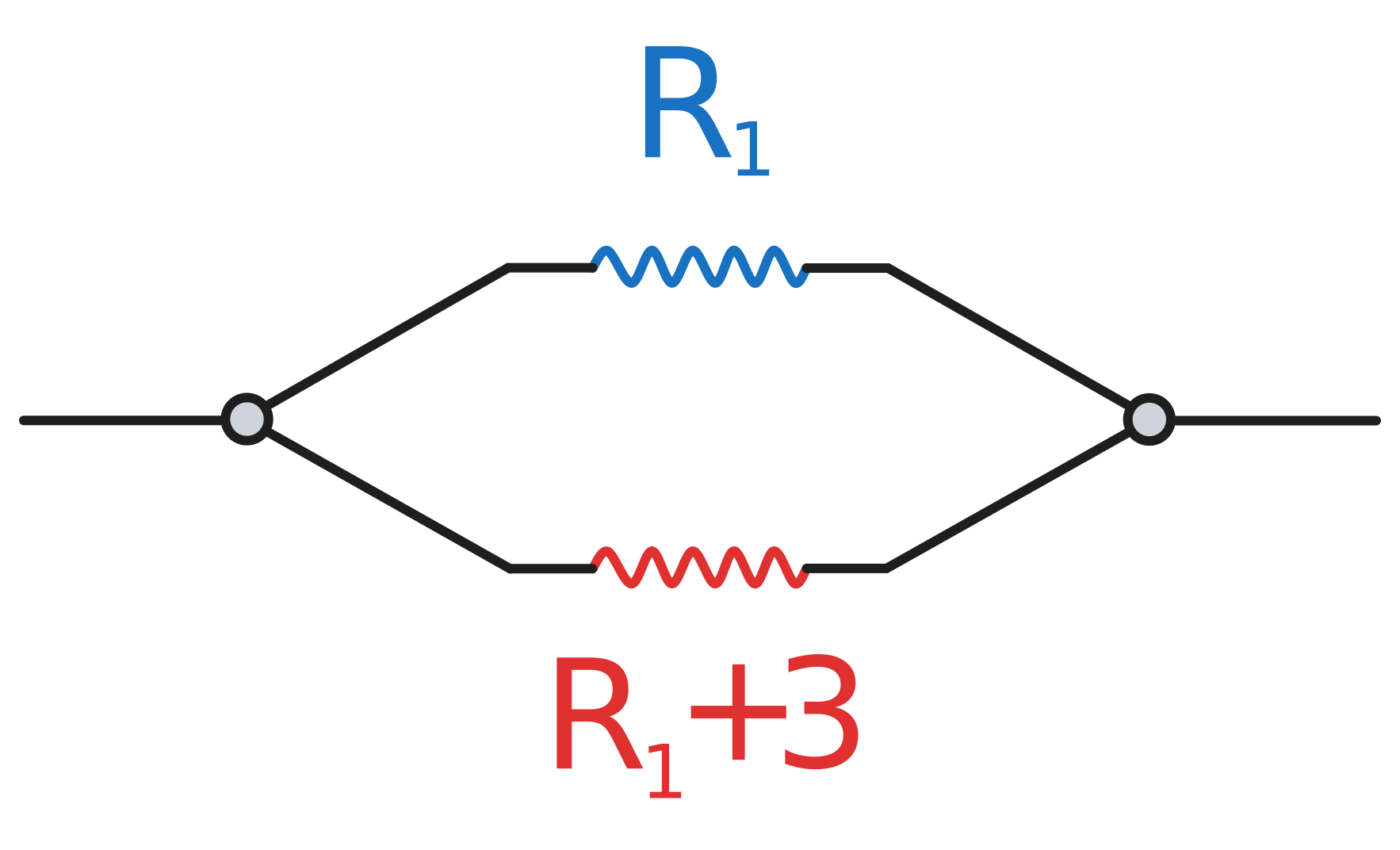
A repairman gets an electric heater made of two heating elements connected in parallel. Everything is sealed in epoxy, so measuring the resistance of each element separately is impossible, but the customer says one element has resistance 3 ohms greater than the other. The repairman measures the total resistance of the circuit and gets 2 ohms. Find the resistance of each heating element.
Uniform Motion
You can invent a stupid amount of puzzle problems from motion at constant speed. Even people who hate physics know the simple formula , which links distance, speed, and time. It is pretty intuitive that if you sprint to the store for chocolate at V = 2 meters per second, then in t = 10 seconds you will cover meters.
From that basic distance formula, you can derive formulas for speed and time by simple transformations. That gives the famous school trio:
Ferry Excursion
🤔
Intermediate
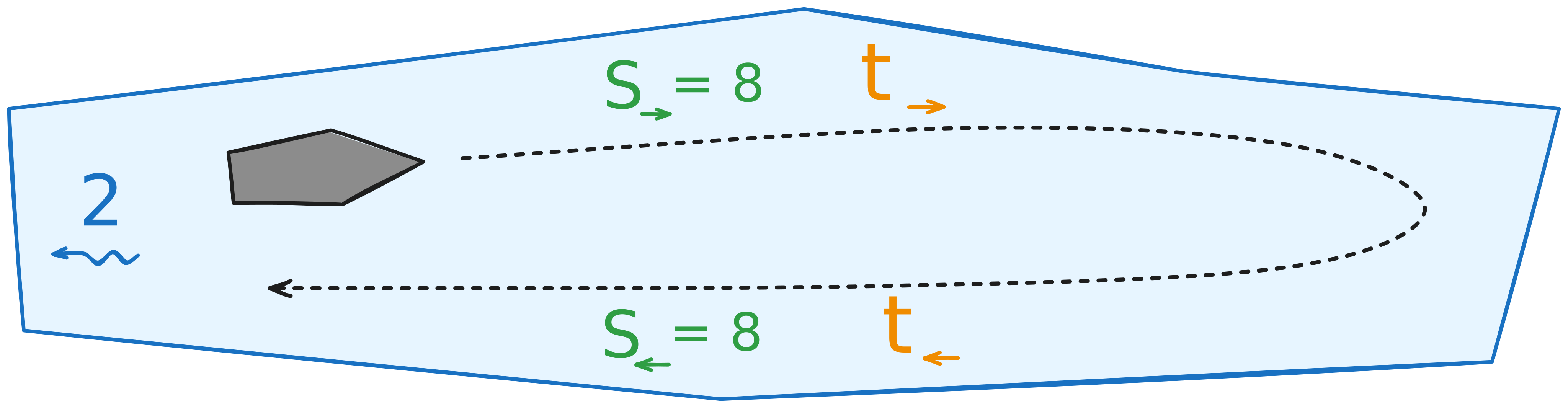
You go on a ferry excursion. The whole thing lasts 3 hours, during which the ferry travels 8 kilometers upstream and then returns back. The river current speed is 2 km/h. What is the ferry’s speed, and how long did it spend going upstream?
Hunting for Speed
🤔
Intermediate
A tourist paddled a kayak 15 kilometers upstream and 14 kilometers downstream, spending exactly as much time as it would take to paddle 30 kilometers in still water. Find the kayak’s own speed if the current speed is 1 km/h.
Long Hike
🤔
Intermediate
A tourist went on a hike. The route is a decent one — 40 kilometers long. If the tourist had walked 1 km/h faster, the whole route would have taken 2 hours less. How many hours did the tourist spend hiking?
Two Delivery Drones
Inter-Subject
🤔
Intermediate
Two cargo delivery drones were launched simultaneously from the roof of a tower: the first flew due east, and the second flew due north. The northern drone flies 3 km/h faster than the eastern one. After 2 hours, the GPS trackers show the distance between the drones is 30 km. How far did each drone fly?
Work
The classical constant-speed formula S = Vt can be generalized to basically any problem where there is some kind of “work” in the everyday sense, done by someone or something at some rate over some time.
Distance S gets replaced by some “amount of work” W, whatever units it may use: the area of a fence to paint, the volume of a tank to fill, the number of parts a factory has to make, and so on. Speed V becomes “productivity”, “output”, or just a work rate P: how many square meters get painted per hour, how many liters flow into a tank per minute, how many parts get made per day, and so on.
The formulas are exactly the same, only the letters change. For example, if a worker makes P = 8 parts per hour, then in t = 10 hours they make parts. That gives the main formula W = Pt, and from it you get the work-rate and work-time formulas, exactly like in constant-speed motion:
Painting a Fence
🤔
Intermediate
Working together, two workers can paint a fence in 6 hours. Working alone, the first worker could paint the fence 5 hours faster than the second worker could alone. How many hours would each worker need on their own?
Plowing a Field
🤔
Intermediate
One tractor brigade plowed 240 hectares, while another plowed 35% more. Each day the first brigade plowed 3 hectares less than the second, but finished two days earlier. How many hectares per day did each brigade plow, given that both exceeded the planned daily quota of 20 hectares?
3 Taps — 1 Tank
🤯
Advanced
A liquid flows into a tank through three inlet taps. If all three taps are opened at once, the tank fills in 6 minutes. If only the second tap is used, the tank fills in 3/4 of the time needed by the first tap alone. The third tap alone fills the tank in 10 minutes longer than the second tap alone. How long does each tap take to fill the tank by itself?
Solutions, Alloys, Gas Mixtures
In chemistry, including everyday chemistry, in metallurgy, and even in plain old concrete mixing, you constantly run into situations where substances are combined. In English, mixture is the broad general word,solution is used when one substance is dissolved in another, and alloy is the standard word for a metallic mixture. So in this section we will look at a liquid solution, a metal alloy, and a gas mixture.
For all these systems, it is crucial to understand what fraction of the total mass or volume is made up by the substance you care about. For example, what fraction of an acid-and-water solution is acid. That ratio is called the concentration of the substance, say A, and it is denoted by c.
Concentration is usually written in percent, but in calculations you use decimals. For example, a hydrogen peroxide solution with concentration 3% means c = 0.03.
Salt Solution
😀
Elementary
A solution containing 18 grams of salt has another 600 grams of water added to it, after which the concentration of the solution decreases by 4%. Find the original salt concentration.
Metal Ingot
🤔
Intermediate
There are two copper alloys with another metal, and the relative copper content in one of them is 40% lower than in the other. A piece of the first alloy containing 6 kg of copper is melted together with a piece of the second alloy containing 12 kg of copper. The resulting ingot contains 36% copper. Find the copper percentage in the first alloy.
Gas Mixtures
🤯
Advanced
A vessel with capacity 8 liters is filled with air containing 16% oxygen. Some amount of air is let out and the same amount of nitrogen is pumped in. Then the same amount of the new mixture is let out again, and again replaced by the same amount of nitrogen. In the final mixture, the oxygen concentration is 9%. How many liters are released each time?
Mathematics
And of course, quadratic equations are used in mathematics itself. Plenty of fun questions in both algebra and geometry lead straight to them. Here are some examples from both areas.
Algebra
Sum of Consecutive Numbers
😀
Elementary
The sum S of the first n natural numbers () can be found using the formula:
How many natural numbers from the start must be added so that the sum becomes 465?
Sum and Product
😀
Elementary
There are two sneaky numbers whose sum is 22 and whose product is 120. What are these numbers?
Jumping Digits
🤔
Intermediate
There is a two-digit number whose digits multiply to 12. If you add 36 to the number, the digits swap places. Find the number.
Geometry
Rectangle Sides
😀
Elementary
The perimeter of a rectangle is 46, and its diagonal is 17. Find the sides of the rectangle.
Triangle Sides
😀
Elementary
The hypotenuse of a right triangle is 5. If the smaller leg is tripled and the larger leg is multiplied by ten, the hypotenuse of the enlarged triangle becomes 41. Find the lengths of the original legs.
Area and Perimeter
😀
Elementary
The area of a rectangle is 50, and its perimeter is 30. Find the sides of the rectangle.
Mysterious Squares
🤔
Intermediate
The sides of two squares are proportional to the numbers 5 and 4. If each side is reduced by 2, then the difference of the new square areas is 28. Find the original side lengths.