
Vieta’s Formulas
Additional
Connections:
Statistics:
- Statement1
- Important3
- Problem17
- Updated
From roots to coefficients
We already carried out factoring of a quadratic trinomial in standard form. In the end we arrived at this beautiful equality:
Let’s expand the brackets on the right-hand side:
Since these expressions are equal, the coefficients of the same powers of the variable x must also be equal. Let’s mark them with colors so it is easier to see:
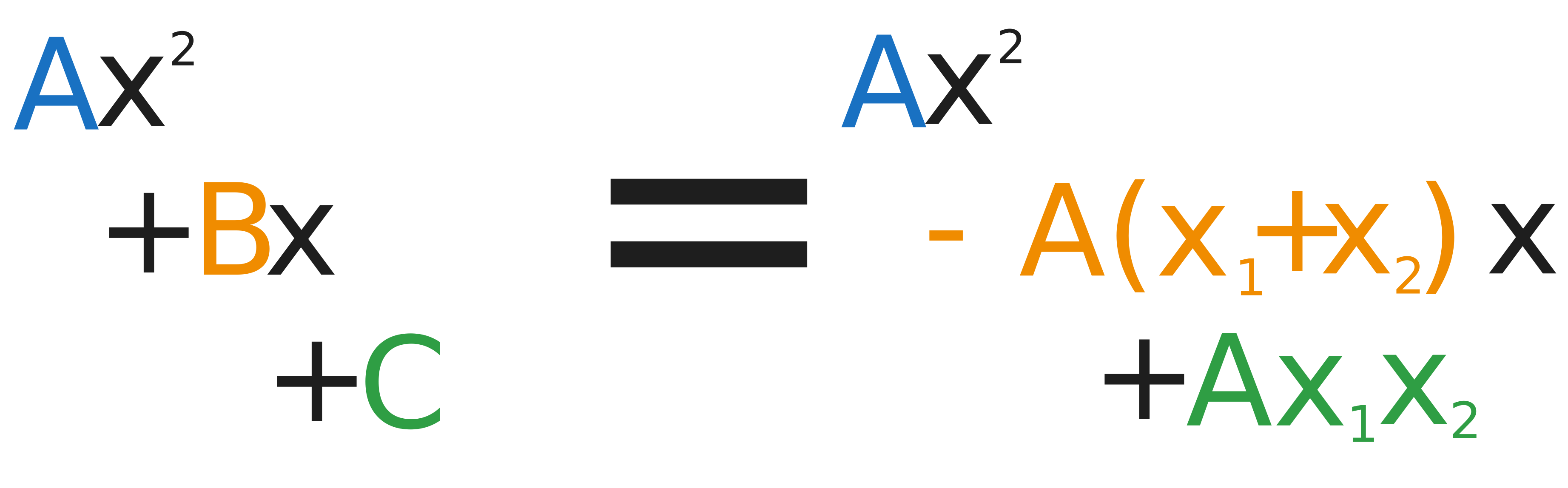
The equality A = A is obvious so we skip it. But the other two equalities are very interesting. Let’s rewrite them so that one side has only roots and the other side has only coefficients:
The connection between roots and coefficients
If a quadratic equation has roots and , then those roots are tied to the coefficients of the quadratic trinomial A, B, and C by two simple formulas:
Maybe not only the roots?
We found a nice simple connection between the roots and the coefficients of a quadratic trinomial. But do only the roots satisfy these formulas? What if there is some other pair of numbers, say n and m, which are not roots, but whose sum and product give the exact same results?
The quadratic trinomial looks like this:
Let’s rewrite it so we can substitute our sum and product into it:
Substitute the coefficient expressions with the expressions involving the numbers n and m, then factor it by hand:
Notice that the expression we got matches the general factoring form exactly. That means our “maybe not roots?” numbers n and m are roots after all:
These can only be the roots!
There is no other pair of numbers, besides the actual pair of roots itself, that satisfies the connection formulas between the roots and the coefficients of a quadratic trinomial.
In other study materials you might see a different wording, but it means the same thing:
You can guess the roots
If you somehow (for example, by guessing) found two numbers that satisfy the connection formulas between roots and coefficients, then those two numbers must be the roots of the corresponding quadratic equation.
Why do we even need this statement? It may look obvious but it is not. Without this statement we have no guarantee that numbers which fit the coefficient formulas are actually roots of the equation. For example, you might guess the numbers 2 and 3, they fit the formulas, but are not roots of the equation! That is why we proved separately that if numbers fit the formulas, then they are definitely roots too!
Vieta’s formulas
We proved two pretty curious statements: that the coefficients and roots of any quadratic trinomial are linked by simple formulas, and also that there is no other pair of numbers that satisfies those formulas besides the pair of roots themselves. Put those two statements together and you get a very useful result, named after the French mathematician Francois Viete, who was the first to notice this connection.
Vieta’s formulas
The roots and of the quadratic trinomial are tied to its coefficients by two simple formulas called Vieta’s formulas:
There do not exist any other two numbers besides the roots themselves that satisfy these formulas.
Do not get scared by the big curly brace to the left of Vieta’s formulas. It only means that both equalities must hold, not just one of them. You will meet this brace properly in the topic about systems of equations.

The extraordinary Viete
Sir Francois Viete literally changed the language of science. In the 16th century he was the first to systematically denote unknown and known quantities with letters (vowels for unknowns, consonants for knowns), turning bulky wordy equations into the compact notation we still use today.
He was damn good at cryptography too — he managed to break a difficult Spanish cipher during wartime, helping France so much that the other side accused him of sorcery.
Now we need to clear up a few points that often cause confusion and weird mix-ups. Pay attention!
So is it “Vieta’s formulas” or “Vieta’s theorem”?
In English, “Vieta’s formulas” is the usual name, and that is the name we will use here. Some books also say “Vieta’s theorem,” especially when they want to include not only the two equalities themselves, but also the fact that no other numbers besides the roots can satisfy them.
Direct and converse theorems
In some study materials, Vieta’s theorem is split into the “direct” one, or just “Vieta’s theorem,” which is about the connection between roots and coefficients, and the “converse Vieta’s theorem,” which is about only roots satisfying those formulas. Just stick with the name “Vieta’s formulas”, otherwise you will only confuse yourself, and who the hell needs that?
Remembering the formulas
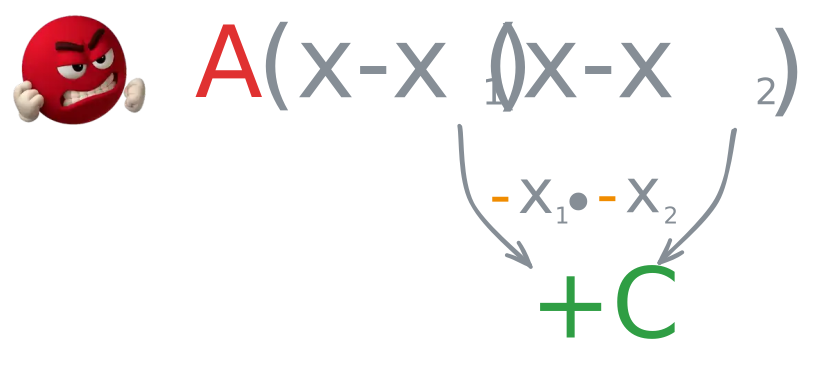
You do not have to memorize them by heart. When you need them, just expand the brackets in and you immediately get the formulas. If you absolutely must memorize something, then just remember that the product of the two negative constants and gives the constant term C. The coefficient A is forever getting under your feet, so you have to divide by it. Then only the negative –B is left for the sum of the roots.
Using Vieta’s formulas
A fair question may come up — why the hell do we even need these formulas? In fact they are very useful, because they give a direct and simple connection between the coefficients of a quadratic equation and its roots. And you can use that connection in all kinds of ways:
Quick root checking
👀
Example
Vieta’s formulas let you quickly check whether given numbers are roots of a quadratic equation.
Usually, checking roots means plugging each number into the equation and checking whether you end up with a true equality.
Check whether the pair of numbers 8 and 3 are roots of the following quadratic equation:
Building equations from roots
👀
Example
Vieta’s formulas let you build quadratic equations “backwards”: from a known pair of roots, get a quadratic equation. Teachers use this all the time to create practice equations for students.
Build a quadratic equation with roots and .
Linking coefficients through the roots
👀
Example
Vieta’s formulas let you “transfer” a relationship between roots into a relationship between coefficients in a quadratic trinomial. This helps you understand what quadratic trinomials with unusual root properties must look like.
What restrictions do the coefficients of quadratic equations have if one root is twice the other? Build three such equations with actual numbers.
Generalizing the formulas
Do such interesting formulas exist only for quadratic equations? Not at all. They are universal and work for equations of any degree. Whatever the highest degree of the equation is, that is how many Vieta’s formulas you get. Here are examples for degrees from 1 to 3:
It works out this way because in fact any equation with a polynomial can be factored into a bunch of factors, not just quadratic trinomials. We are not going to prove that here, and we do not need it yet, but the factorization looks like this:
Expanding the brackets and matching coefficients is exactly what gives Vieta’s formulas for equations of any degree.