
Mental Solving of Quadratic Equations
Advanced
Additional
Connections:
Statistics:
- Statement5
- Important1
- Problem5
- Updated
Any quadratic equation can be solved with the quadratic formula. But there is a special breed of people who like doing everything fast in their head and hate writing shit down on paper. If that’s you too, you’re in the right place.
Mental solving of quadratic equations has a very real upside too — in school, and pretty often even at university, quadratic equations are deliberately picked so their roots come out “nice,” usually integers. If you know how to solve them in your head, you will spend way less time on them. And your classmates will get to watch you do math black magic and stare blankly for a bit. We all want to feel like Gauss or Euler once in a while, right? 😏
Learn to solve them on paper first!
Before you try solving quadratic equations mentally, learn to solve them confidently in writing. It is useless and pointless to do in your head what you still cannot do properly even on paper.
Incomplete Equations
All incomplete quadratic equations can and should be solved mentally. Unlike full quadratic equations, there is nothing to guess there. They always have a straightforward and easy solution.
Ways to solve incomplete quadratics mentally
If you’re supposedly advanced, there should be no “where the hell did those formulas come from?” questions here. You’re advanced and you didn’t come here just for the memes, right? 👀
Kidding 😏 But if you still got stuck, the full derivation lives in the topic on incomplete quadratic equations. From here on we only deal with full quadratic equations, and those are a lot trickier.
Zero Sum
The fastest and easiest method. Honestly, everyone who cares about mathematics should know it, whether or not they plan to solve quadratics mentally.
Zero sum
If the sum of the coefficients of a quadratic equation is 0, then one root is 1, and the other is C/A. If you take the sum using negative –B, then both roots are negative too:
Proof
Roots 1 and –1 are easy enough, but how do you remember the second root? You can forget it if you want. No tragedy. Just use the second Vieta formula, the one about multiplication:
Now look at the examples and drill this method properly on actual equations instead of just nodding along.
Zero sum — Practice
Method
😀
Elementary
Decide mentally whether the quadratic equation can be solved by the zero-sum method. If yes, solve it mentally too. If not, explain why.
Because this check is so stupidly simple and so effective, you should always test the coefficient sum first, before you start solving by hand or move on to trickier mental methods. It takes a couple of seconds and sometimes gives the answer instantly.
Perfect Square
If there are formulas that never leave you to die, it is the special-product formulas. More specifically, the square of a sum and the square of a difference:
If you get lucky, the whole quadratic equation can be packed into one squared bracket and the root drops out immediately.
Perfect square
If both outer coefficients A and C of a quadratic equation are perfect squares (), then maybe the entire equation can be packed into the square of a sum or the square of a difference. That depends on whether the middle coefficient B can be split into the product of 2 and the square roots of the other two coefficients:
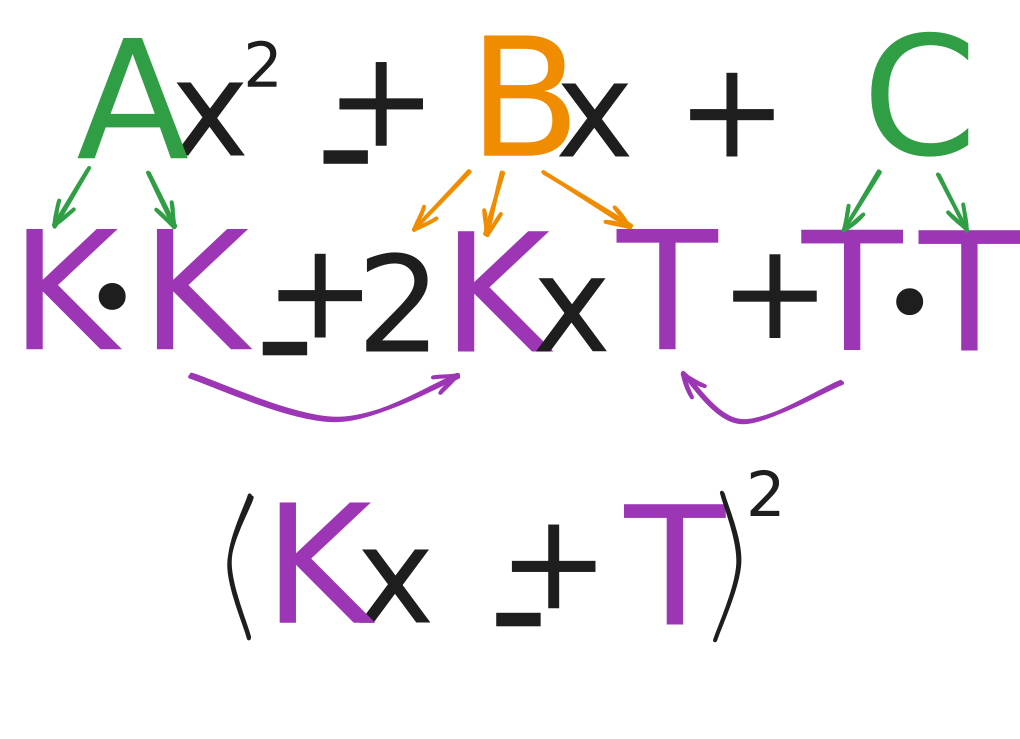
If that packing works, then the equation has exactly one root, and the sign of this root is the opposite of the sign in front of coefficient B:
Proof
How do you remember which number goes in the numerator and which in the denominator? Easy. In basically every formula involving quadratic trinomials and equations (the quadratic formula, Vieta’s formulas, even the zero-sum method above), coefficient A somehow always ends up downstairs, in the denominator.
And in the current formula, K came from A. So it gets dragged downstairs too. That is why K sits in the denominator. Here is what the method looks like on actual equations:
Perfect square — Practice
Method
🤔
Intermediate
If the equation can be solved by the perfect-square method, solve it mentally. If not, explain why it fails.
Factoring
Now for the real classic: factoring. This is the method you should try when the equation in front of you is monic, meaning its coefficient is A = 1:
To solve these and many similar equations, it is enough to factor them mentally using the manual factoring technique.
Factoring
A monic quadratic equation (A = 1) can often be factored mentally. To do that, you must represent coefficients B and C as the sum and product of two numbers. If that works, then the roots are those two numbers, but with the signs flipped.
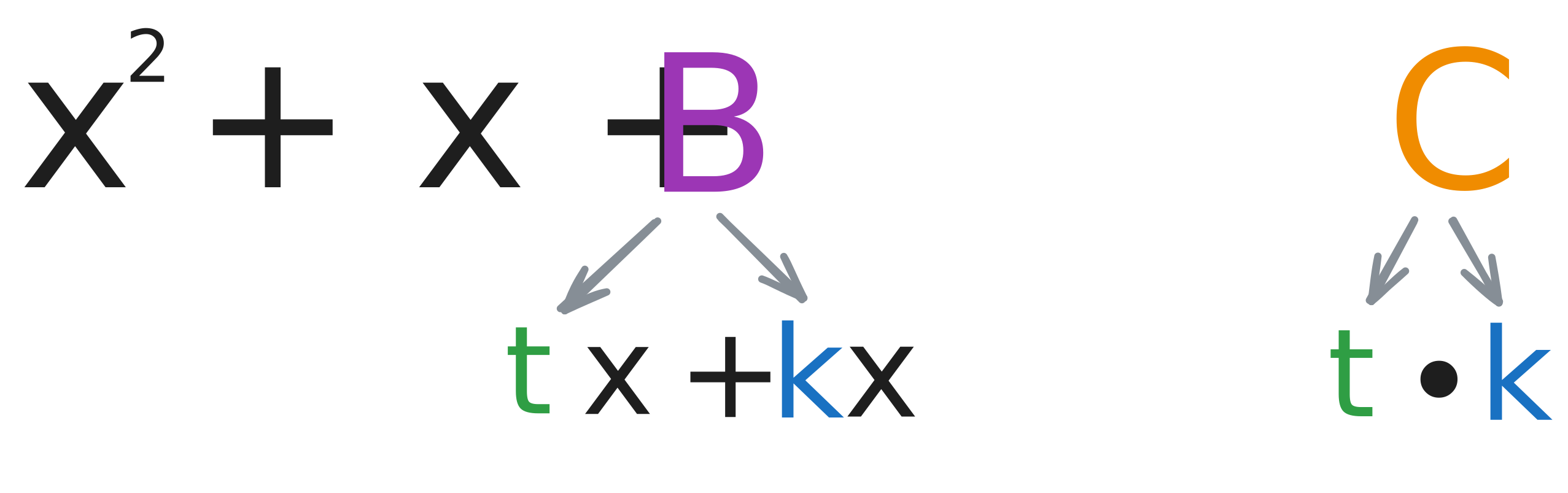
Proof
Some people prefer picking roots that fit Vieta’s formulas right away. That also means hunting for a sum and a product. But there is an annoyance there: instead of the visible sum B, you have to mentally look for –B. Annoying. In our method, you do not have to flip anything in your head first. Just find numbers that give B and C, then flip both signs. Much nicer.
Factoring mentally gets a lot easier once you can instantly tell what signs the numbers in the factorization must have. You can do that with a simple trick first mentioned in the problem Factoring signs. Good problem, by the way. Solve it if you have not already. The general rule is as follows:
Factoring signs
You can determine the signs of the numbers t and k in the factorization of a quadratic trinomial from the signs of coefficients B and C:
Proof
Now that you know how to determine the signs you need, try solving quadratic equations mentally by factoring:
Factoring — Practice
Method
🤔
Intermediate
If possible, solve the quadratic equation mentally by the factoring method. If not, explain why.
Transfer A To C
In most cases, if all the easy mental methods above fail, that is enough to give up and slink back to the quadratic formula in disgrace. But there is one last bonus secret method that lets you get rid of coefficient A and try factoring mentally anyway.
Transfer A to C
In any quadratic equation , you can “transfer A to C” and get the monic equation . The roots and of the original equation are equal to the roots and of the monic one, divided by A.
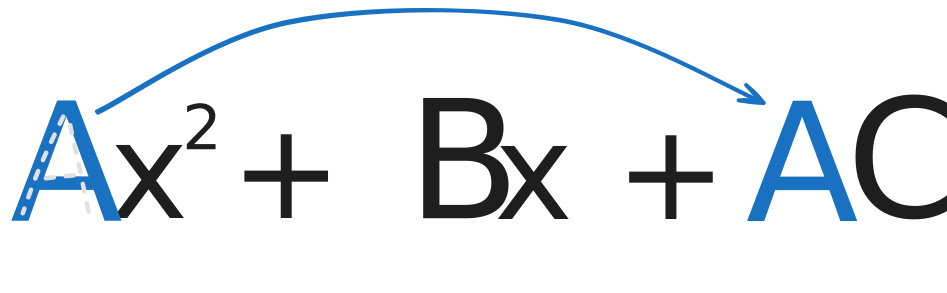
Proof via Vieta’s formulas
Proof via the quadratic formula
Yes, you are absolutely right: first you turn one quadratic equation into another one, then solve that new one in your head, then divide the roots mentally by A. A method for real freaks, but sometimes it saves you. Here is what it looks like in practice:
Transfer A to C — Practice
Method
🤯
Advanced
By the way, remembering what you divide the roots of the monic equation by is easy too. Again, coefficient A lives downstairs in the denominator. So that is what you divide by.
Everything At Once
Let’s gather all the mental methods for solving general quadratic equations into one scheme, ordered from easiest to hardest:
Ways to solve quadratic equations mentally
Ordered from easiest to hardest
Practicing each method separately is good when you are just learning them and trying to memorize the patterns. But to build an actual skill in mentally solving quadratic equations, you need to practice them all together, on equations that do not scream which method fits. That is exactly what we do next.
Mental solving of quadratic equations
🤔
Intermediate