Completing the Square
Connections:
Statistics:
- Term1
- Important1
- Problem11
- Updated
We have already learned to determine whether an equation is quadratic. We even learned to solve their simplified forms — incomplete quadratic equations. But enough half-measures! It’s time to learn how to solve any quadratic equation! And the process called completing the square will help us with this.
What is this “completing” thing?
There are two wonderful, very useful and frequently used formulas called square of a sum and square of a difference (not to be confused with “difference of squares”!). It is difficult to even call them formulas, these are just two different notations for the same thing. They look like this:
These are two of the three basic special products formulas. You can verify their correctness if you simply expand the parentheses on the left side of the equation and combine like terms.
Using one of these formulas, we “unpack” the squared expression, getting an expanded one. But since the expression can be “unpacked” into a long one, is it possible to reverse the process — “pack” a long expression into a squared one? It is possible. Such a process is called completing the square!
Completing the square
The process of “packing” an expanded expression into a squared binomial (a parenthesis squared):
Examples:
The last example from the definition looks suspicious, right? That’s because the “packing” doesn’t always go smoothly. We will talk about this below, not essential for now.
Why bother?
Most likely, you have one small question… Why the heck do this? Where can completing the square be useful? There are actually two reasons:
1
To the great joy of mathematicians (and ours too), completing the square turned out to be the key to solving any quadratic equation in general form!
2
This allows simplifying expressions! Before completing the square, the unknown occurs in the expression twice — in the second and first degree.
After completing the square, the unknown occurs only once. This can be useful not only for solving equations but also for other tasks.
Different notations — Same value
Packed and unpacked forms denote the same object, just written differently. All three of the following expressions are essentially the same:
The first is the “unpacked” form, the second with 3z factored out, and the third with the completed square. Just as numbers , and 0.5 — are different notations for the same value. In different situations, it is convenient to use different forms of notation!
We have learned what completing the square is and why it is needed. Let’s get to know this process a little better! Let’s learn how to perform it ourselves!
Geometric completion
Before we start all this abstract fussing with letters, let’s first visualize the process. Just like in the good old days of Euclid and Pythagoras. And it will immediately become clear to you why the process is called “completing the square”.
Let’s start with this expanded expression:
Let’s try to pack it into a squared expression, that is, complete the square. To do this, let’s represent this expanded expression as the sum of the areas of three figures:
1
A square with side p. Its area is .
2
A rectangle with sides 6 and p. Its area is 6p.
3
A square with area 9.
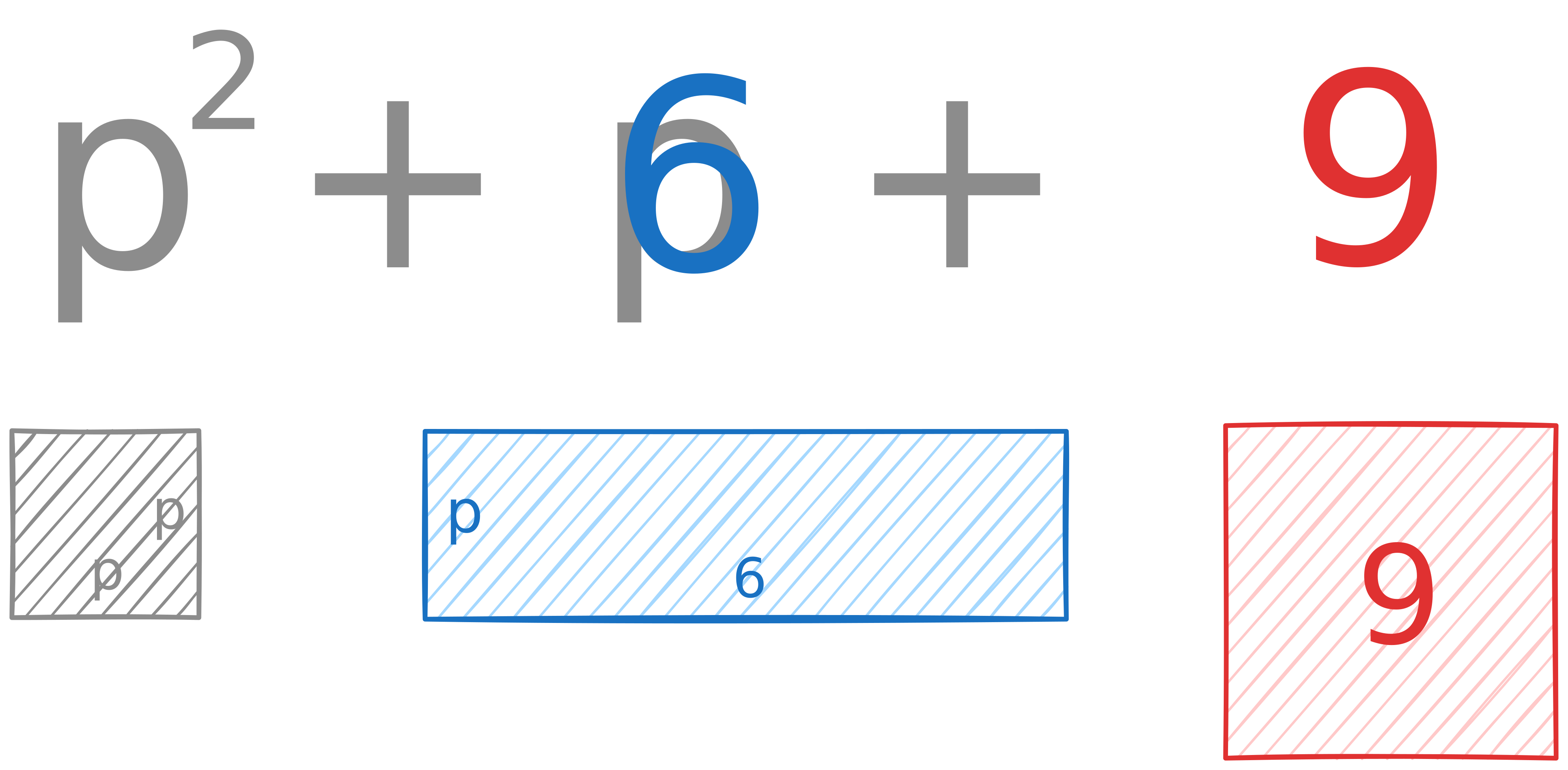
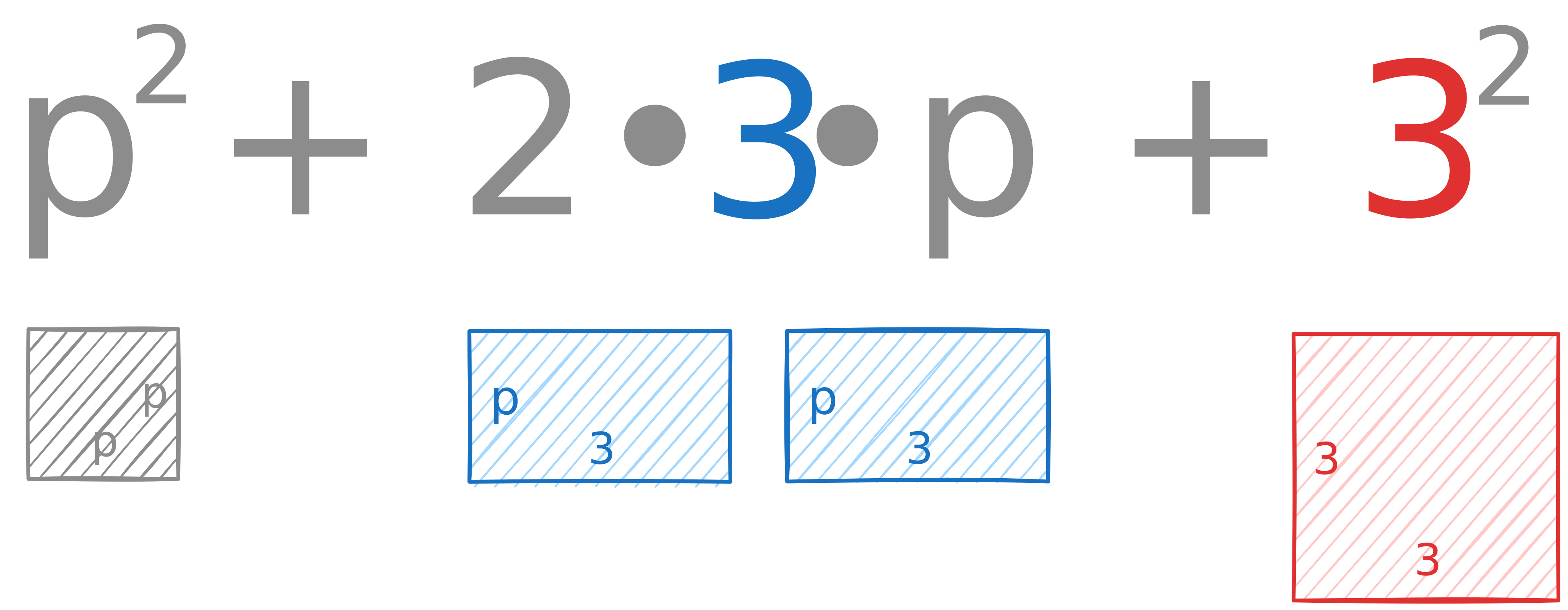
A rectangle with area 6p can be “cut” into two identical rectangles with sides 3 and p. And the square with area 9 has sides equal to 3. Notice how we intentionally obtained two identical numbers (threes) in the middle and on the right side of the expression!
Now all these figures can be combined with each other along sides with equal lengths. This creates one large square with side p + 3!
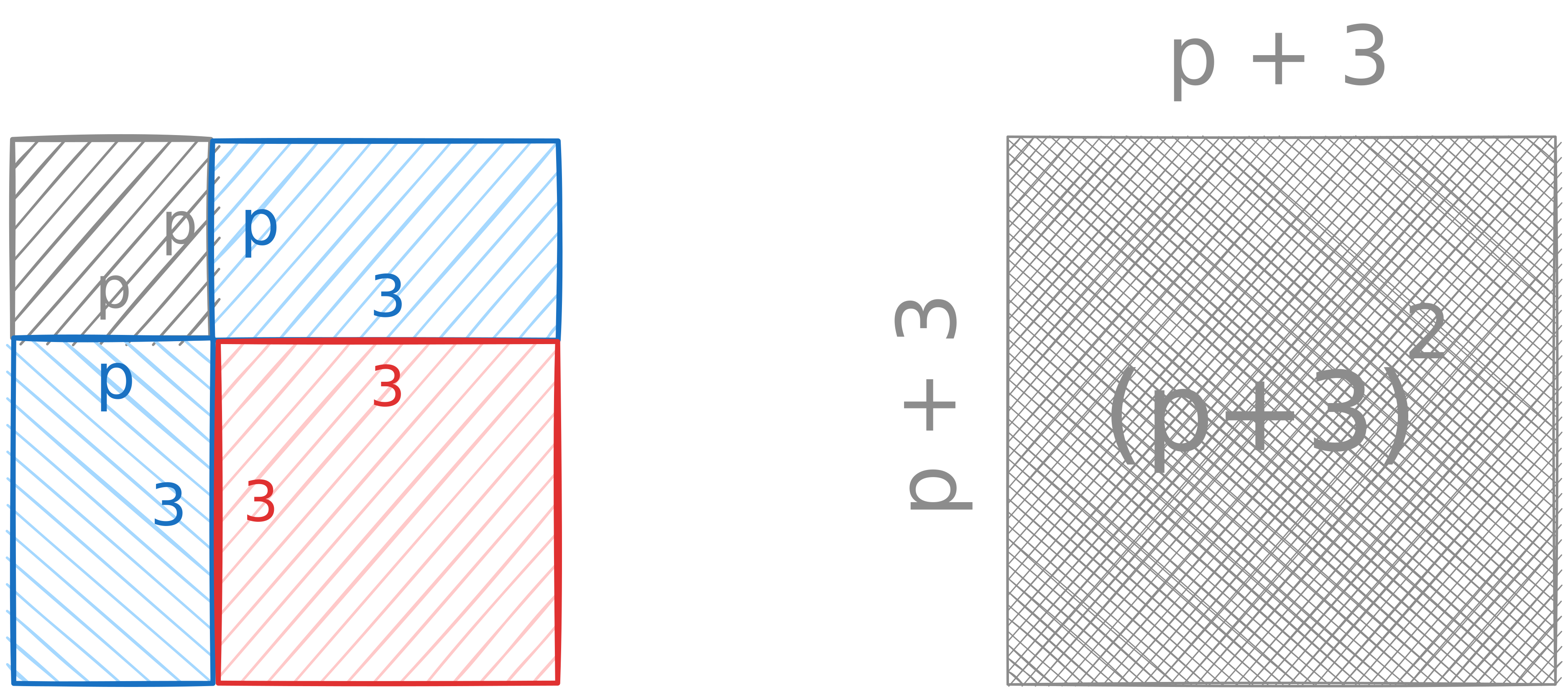
The total area of this large square is . We didn’t add or remove anything, only cut and rearranged the figures. So, the original sum of areas and the resulting area are the same!
The correctness of the result obtained can be verified simply by expanding the parentheses and combining like terms.
Now you have visually seen what completing the square is. And the name no longer seems so mysterious. Because from the available pieces: unknown square , rectangle 6p and another square we assemble or complete a new large square with side p + 3.
Algebraic completion
No matter how good the visualization looks, it has a few downsides. There isn’t always space at hand to draw rectangles and squares. Also, it only works well with positive terms. If some terms are subtracted, then you have to change the approach and get perverted in every way.
And this is exactly where abstractions and algebra come to our aid. It doesn’t give a damn about drawings, only numbers and formulas, only hardcore! Let’s learn to carry out the process of completing the square manually and without any drawings. Let’s start with this expanded expression:
To begin with, we need to understand which special product formula we can match this expression to: square of a sum or square of a difference . We see a negative sign in the middle term, which means we will pack into the square of a difference .
Rewrite this expression so that it takes the form (something squared minus two multiplied by something plus something squared). In our case can be represented as . In the center, the term –20p can be represented as . On the right, the number 4 can be represented as .
We have successfully reduced the expression to the form of the expanded square of a difference. Notice that the role of a is played by 5p, and b by the number 2. So we can pack this expression into the square of a difference :
Completing the square went successfully and without any drawings!
Practice performing this process on a few examples to get used to it:
Completing the square
👀
Example
Algebraically complete the square in the expression:
Completing with incomplete terms
Remember that last weird example from the definition? For some reason, there was an ugly “tail” in the form –1/4 next to the squared expression. We’ll deal with this right now. Until now, all components for completing the square were inherent in the original expression. But sometimes a component is missing. Let’s consider such an example:
We see a plus, which means we can try to pack this expression into the square of a sum . To do this, it must be brought to the form . On the left we already have , which means a = x. But then problems begin. We don’t have a two for 2ab, as well as b and . Such situations are encountered constantly.
Fortunately, nothing prevents us from adding missing terms and immediately compensating for them, so that the total value of the expression remains unchanged. For example, we can multiply by 2 and divide by 2 right there. The final value has not changed, but we have added the necessary terms:
We already have a, which is x. There is also 2ab, which is . Then b is 5/2. To get the “packable” form of the square of a sum, all that remains is to add , that is 25/4, and immediately subtract it, so that the final value does not change:
Completing the square was successful, even though we are left with a “tail” in the form of an extra constant. This “tail” compensates for everything we added to complete the square:
As you can see, we can add absolutely any term we need. The main thing is not to forget to immediately compensate for it! In fact, adding terms to bring expressions to the desired form is a powerful and regularly applied trick in all of mathematics. It would seem that we, on the contrary, clutter the expression by adding extra terms, but hell no, because part of these terms will be “packed”!
Practice the advanced process of completing the square by adding the necessary terms:
Completing the square with incomplete terms
👀
Example
Complete the square in the expression by adding and compensating terms:
Congratulations, you officially learned how to complete the square in any situation! Pretty cool, huh? Can’t see a happy face! Rejoice harder!
Solving quadratic equations
Maybe you didn’t even notice this, but you have already learned how to solve quadratic equations, any of them! The thing is, completing the square allows us to easily move from a quadratic equation to a regular linear one (without powers), which is solved elementarily. Let’s try to solve our first ever full quadratic equation:
First, complete the square of the expression on the left side of the equation. We are missing terms for completion, but we already know how to work with such situations.
Isolate the completed square, that is, leave it alone on one side of the equation, and move all other terms to the other side. To do this, by the same action rule add number 16 to both parts of the equation:
For convenience, replace the expression in parentheses (x + 3) with variable t (from the word temporary — but actually any letter could have been chosen):
Now let’s use our brains a bit. A number t is squared, that is, multiplied by itself, and we get 16. What number is this? Of course, it’s either 4, or –4! So we get two possible values for t:
But we are looking not for t, but for x. Therefore, perform the reverse substitution, solve two sub-equations and get two roots of the original equation:
Congratulations, you just solved your first full quadratic equation! The equation has two solutions: 1 and –7. You can verify the correctness of this solution by substituting them into the original equation and checking for a true equality.
Let’s try to solve some more quadratic equations and see what surprises they might have in store.
Quadratic equations via completing the square
👀
Example
Solve the quadratic equation by completing the square:
That’s it! Now you can solve any quadratic equation! The difference compared to elementary equations is, of course, significant. We had to go through a whole preparatory journey: getting to know quadratic equations, solving their incomplete forms, and mastering the art of completing the square.
In future materials, we will derive universal general formulas for solving quadratic equations, which are much more convenient to apply than completing the square each time. We will also study interesting properties of quadratic trinomials and equations. So stay tuned, it will be interesting!