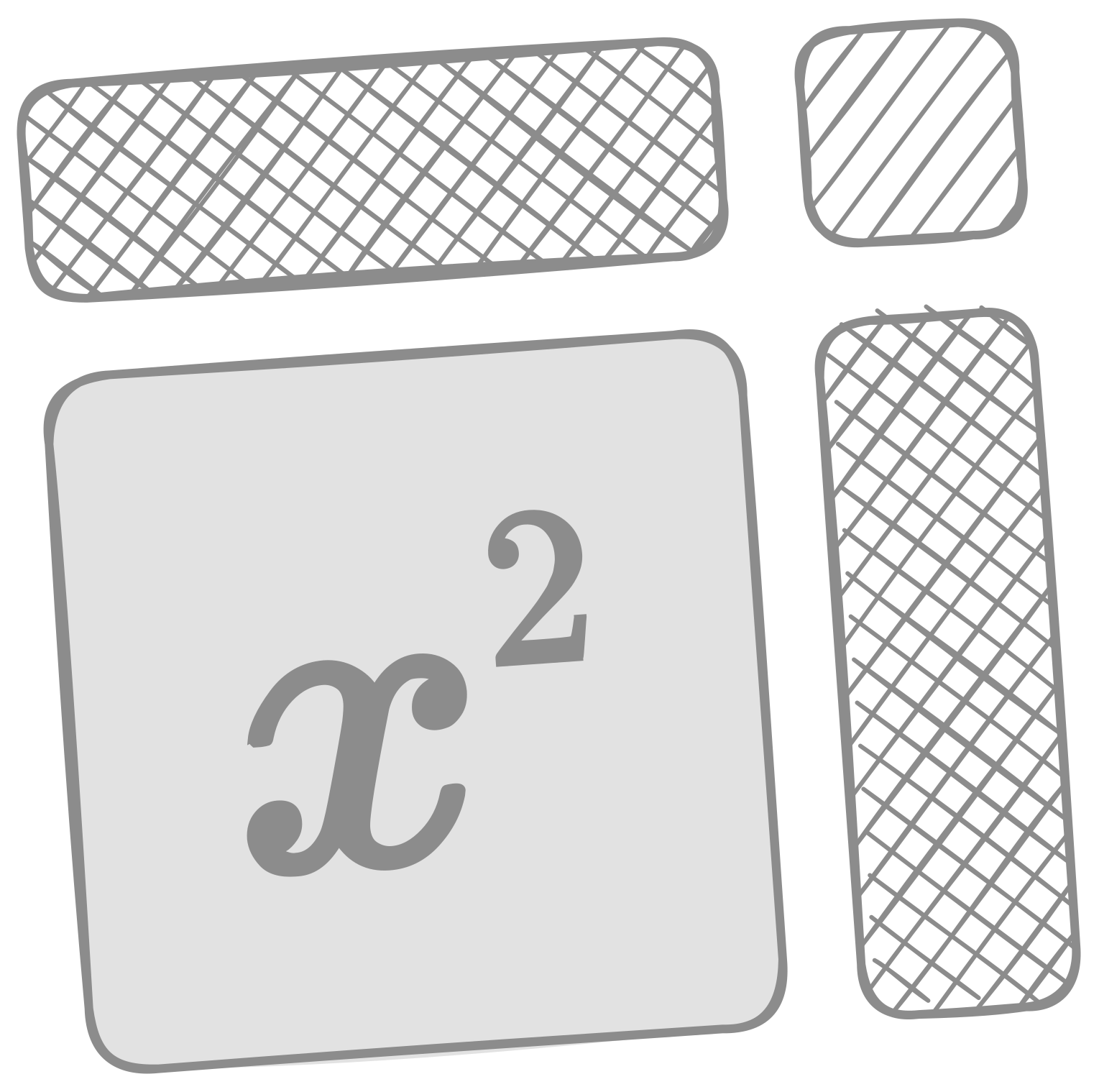
What is a Quadratic Equation?
Connections:
Statistics:
- Term2
- Important1
- Problem5
- Updated
The Same Action Rule is, of course, a very powerful tool that allows one to easily handle simple equations by reducing them to the trivial form x = A or A = x. However, there are often equations that cannot be simplified to such form:
Equations with a nuance…
Applied
👀
Example
An ancient Greek king (they were called basileis) ordered a luxurious garden to be built with an area of 36 square meters. Also, one of its sides must be 5 meters longer than the other. What should be the length and width of the garden?

Ancient sages are confused…
Before attempting to solve such equations, mathematicians decided to first learn how to define them and identify common features. To do this, they first introduced the concept of a quadratic trinomial:
Quadratic trinomial
Any polynomial written in the following “standard” form:
For example:
If an equation can be reduced without changing roots to a form where on one side there is a quadratic trinomial, and on the other — zero, then such an equation is called “quadratic”.
Quadratic equation
The general form of a quadratic equation is any equation that has a quadratic trinomial on one side and zero on the other:
Any equation that has this general form or can be reduced to it by transformations without changing the roots is called a quadratic equation:
Power matters, not position
The vast majority of beginners get confused when determining the coefficients A, B and C in a quadratic equation. Coefficients are attached to the powers of x. But the positions they occupy do not matter!
1
Coefficient A always stands next to .
2
Coefficient B always stands next to x.
3
Coefficient C always stands alone. There are no variables next to it!
Consider the example . Remember that A is always before , so it is equal to 4. B is always before x, so it is equal to –2. –3 stands alone; this is the coefficient C.
Quadratic or not?
😀
Elementary
Check if the equation is quadratic or not. If the equation is quadratic, using the same action rule, bring it to the general form and find the values of its coefficients A, B and C.