Vieta’s Formulas
Additional
Connections:
Statistics:
- Statement1
- Important3
- Problem17
- Updated
Deriving Vieta’s formulas
Vieta’s formulas
The roots and of the quadratic trinomial are tied to its coefficients by two simple formulas called Vieta’s formulas:
There do not exist any other two numbers besides the roots themselves that satisfy these formulas.
So is it “Vieta’s formulas” or “Vieta’s theorem”?
In English, “Vieta’s formulas” is the usual name, and that is the name we will use here. Some books also say “Vieta’s theorem,” especially when they want to include not only the two equalities themselves, but also the fact that no other numbers besides the roots can satisfy them.
Direct and converse theorems
In some study materials, Vieta’s theorem is split into the “direct” one, or just “Vieta’s theorem,” which is about the connection between roots and coefficients, and the “converse Vieta’s theorem,” which is about only roots satisfying those formulas. Just stick with the name “Vieta’s formulas”, otherwise you will only confuse yourself, and who the hell needs that?
Remembering the formulas
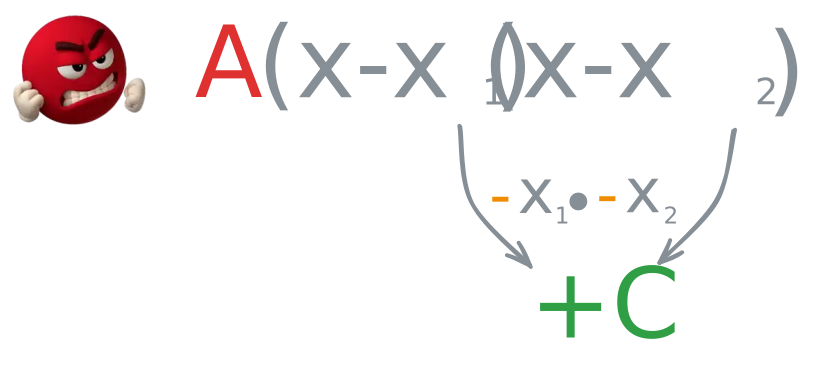
You do not have to memorize them by heart. When you need them, just expand the brackets in and you immediately get the formulas. If you absolutely must memorize something, then just remember that the product of the two negative constants and gives the constant term C. The coefficient A is forever getting under your feet, so you have to divide by it. Then only the negative –B is left for the sum of the roots.
Using Vieta’s formulas
The main value of Vieta’s formulas is that they connect the roots of a quadratic equation with its coefficients in a simple, direct way. That connection can be used in all sorts of ways:
Quick root checking
👀
Example
Vieta’s formulas let you quickly check whether given numbers are roots of a quadratic equation.
Usually, checking roots means plugging each number into the equation and checking whether you end up with a true equality.
Check whether the pair of numbers 8 and 3 are roots of the following quadratic equation:
Building equations from roots
👀
Example
Vieta’s formulas let you build quadratic equations “backwards”: from a known pair of roots, get a quadratic equation. Teachers use this all the time to create practice equations for students.
Build a quadratic equation with roots and .
Linking coefficients through the roots
👀
Example
Vieta’s formulas let you “transfer” a relationship between roots into a relationship between coefficients in a quadratic trinomial. This helps you understand what quadratic trinomials with unusual root properties must look like.
What restrictions do the coefficients of quadratic equations have if one root is twice the other? Build three such equations with actual numbers.