
Elementary Equations
Connections:
Statistics:
- Term3
- Statement1
- Important4
- Problem35
- Updated
Equality
Equality
Two expressions with an equals sign (=) between them.
Equation
Equation
Equality in which there is one or more unknowns or variables.
Solving an Equation
Solutions or roots of an equation are numbers that, when substituted for unknowns, turn it into a true equality.
“To solve an equation” means to find all its roots and prove that there are no other roots. Moreover, there may be no roots at all, or there may be infinitely many.
Solving Equations by Guessing
👀
Example
Solve all equations:
Same action rule
Same Action Rule
If the same action is performed on both sides of a true equality (add, subtract, multiply, divide, or any other), the resulting new equality will also be true.
There is also a very simple formulation.
Remember it for the rest of your life:
Remember it for the rest of your life:
WHAT WE DID ON ONE SIDE, WE DO ON THE OTHER!
Proof. With ducks and communists!
True Preservation Examples
👀
Example
Try the same action rule for basic arithmetic operations:
What new equality will be obtained if, according to the same action rule, you add the number 2 to the equality below?
Solving equations
Solving almost all equations comes down to sequentially simplifying the original equation by applying the same action rule repeatedly. Simplification continues until it becomes clear what number the unknown represents. Usually, simplifications reduce the equation to the trivial form
Addition is neutralized by subtraction and vice versa, to get 0:
Multiplication is neutralized by division and vice versa, to get 1:
Multiply and divide both sides carefully! Remember that these actions apply to the entire left and right sides, not just where it is convenient! Remember that:
Action is Always “Global”
When transforming equalities, always apply the action to the entire side of the equality as a whole as a single unit, and never to its individual parts!
One Equation — Different Solutions
😀
Elementary
Solve both equations from the problem above in other ways:
This time try to first subtract 4x from both sides of the equation.
Why solve equations?
Equalities and equations are literally everywhere! Countless real-life situations can be reduced to equations, that is, literally translated into the language of mathematics. Therefore, transforming equalities and solving equations is a basic and key skill not only in mathematics, but also in any exact science. Confident mastery of this skill is like a reliable and universal workbench for working with thoughts and ideas.
Applying equations in life
Applied
😀
Elementary
No matter what sphere of human activity you take, you can find equations everywhere!

Alina wants to buy a new phone, which currently costs 10,000 rubles. Every day she saves 100 rubles. However, every day the price of the phone increases by 20 rubles! How many days does she need to save money to accumulate the necessary amount?
Common mistakes
“Equation” is when “equals 0”
A common misconception that arises because many practice equations in textbooks and problem books are written in the form . As you have already seen for yourself from the examples above, to the left and right of the equal sign there can be anything: numbers, variables, fractions and even complex expressions.
“To solve an equation” means to find x
Complete nonsense. Unfortunately, such an illiterate answer you will hear in 90% of cases from schoolchildren and even students. To start with, the variable is not always denoted by the letter x. A variable can be denoted by any letters and symbols, for example y, z, t, , etc.
But generally, as soon as you hear such an answer, immediately poke your finger at x and confidently declare — “Find x? Well, here it is! That’s it? Is the equation solved?”
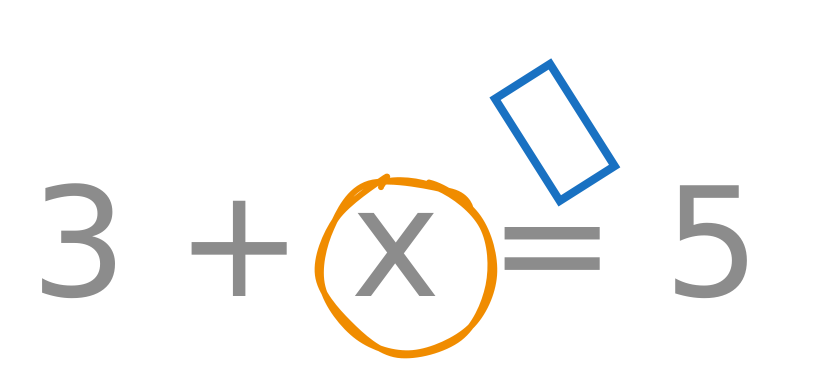
After you finish laughing, don’t forget to tell what it actually means “to solve an equation”.
Solving equations “in a line”
Mathematical expressions can usually be transformed (performing cancellations, opening brackets, collecting like terms) in a single line via a chain of equalities. For example, simplifying the expression , we can write:
Very often beginners try to apply exactly the same approach when solving equations. It looks different every time, but always incredibly creatively, for example:
This is a natural mistake, but it must be nipped in the bud. Doing so is fundamentally wrong! Each new action on both sides, each “internal” transformation, everything must be on a separate line one under another:
Confusion with equivalent transformations
Regularly after studying the rule of the same action on equations and equalities students start confusing it with ordinary expression transformations. Consider this example:
on the left side the fraction can be safely cancelled by 4 and get 2x = 7. But students are afraid to do this, because if “if I cancel the fraction on the left, then according to the rule of same action I have to cancel on the right too”. And since on the right nothing cancels with anything, it means you can’t do that.
Here you just need to understand that cancelling a fraction is essentially just replacing one notation, , with another, 2. Both these notations denote the same number, and therefore they can be freely replaced with each other. Such actions are also called equivalent transformations — the form changes, the value does not. In analogy with mechanical scales this can be compared to removing a weight of 3 kilograms and instead of it putting a bucket of water weighing 3 kilograms — it looks different, the essence is the same.
Never confuse equivalent transformations (cancelling fractions, opening brackets, collecting like terms, etc.), which do not change the essence in any way, with the same action rule, which completely changes the equation! With equivalent transformations no actions are required for “compensation” — there is simply nothing to compensate!