Factoring quadratics
Key elements:
Connections:
Statistics:
Statement1
Important1
Problem9
No-brainer roots
😀
Elementary
Solve the equation:
There and back again
😀
Elementary
Factor the first expression, and rewrite the expression on the right in standard quadratic trinomial form:
Factoring
😀
Elementary
Factor the quadratic trinomial and find the roots of the corresponding quadratic equation:
Bracket chaos
🤔
Intermediate
Simplify the equation down to a product of factors and find the roots:
Master of both elements
Elegant
🤔
Intermediate
Get really damn good at handling quadratic trinomials that are written in two forms at once: as a sum and as a product of factors, yin and yang style. Simplify the expression:
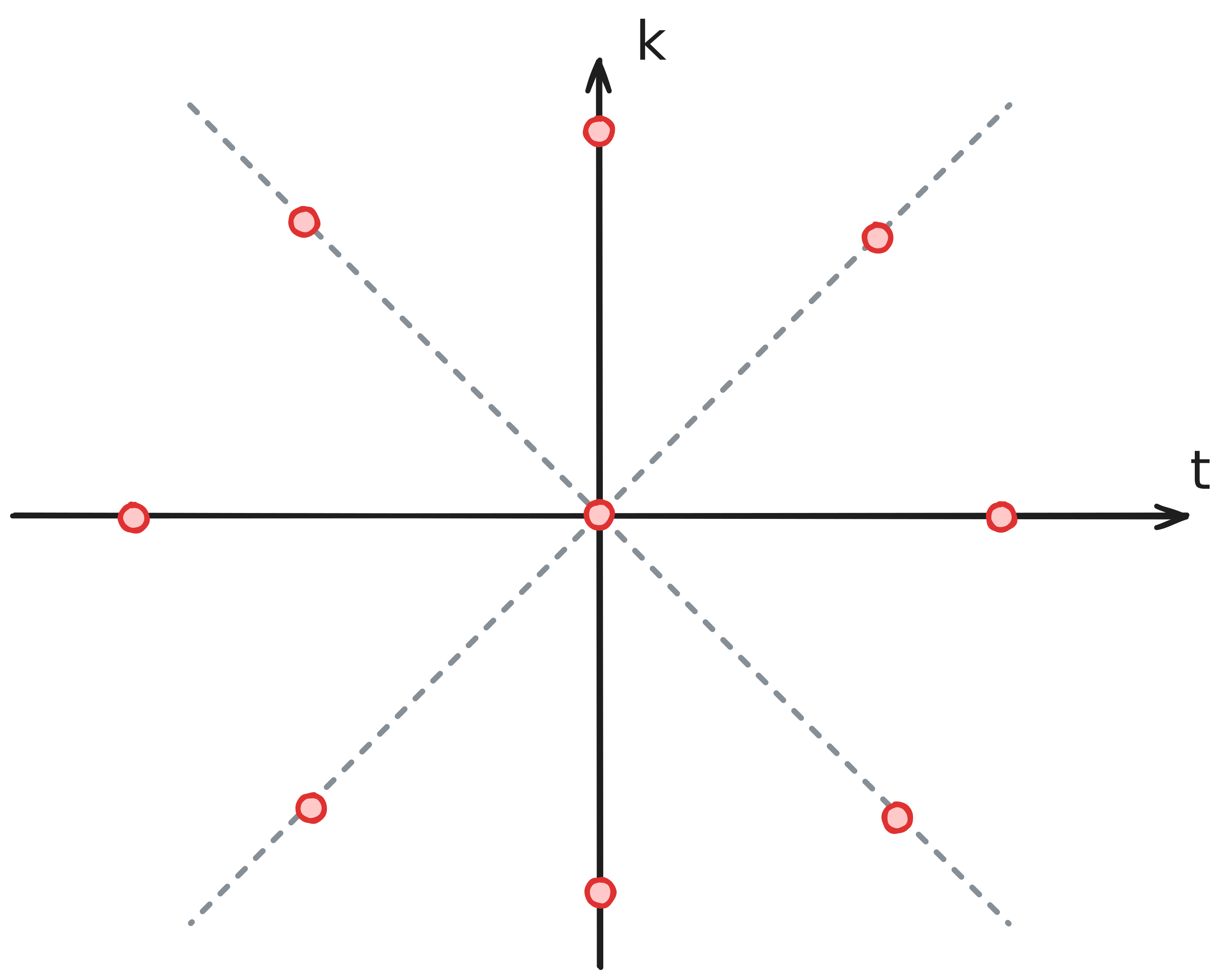
Exploring the trinomial plane
🤯
Advanced
Let's explore the coordinate plane of “rectangular” quadratic trinomials together:
Study what kinds of quadratic trinomials appear at the locations marked with red dots. Describe the general form and give a couple of examples with specific numbers.