
About “Open Math”
Statistics:
- Important2
- Updated
What is this site?
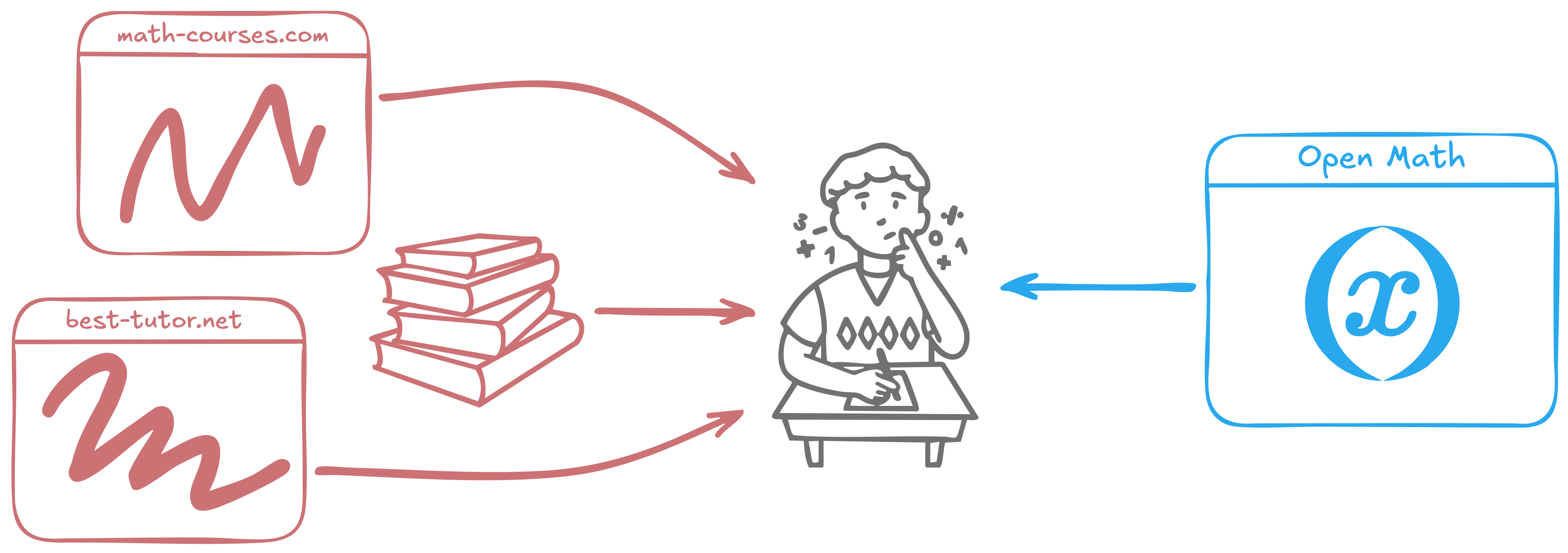
Everyone has internet access today. It contains a huge amount of scattered resources on math with fragmentary data. In some places, the theory is presented well; in others, there are only problems, and so on… And we are creating a single resource with the best materials for learning mathematics, without the need to look for theory or problems elsewhere.
Goal of “Open Math”
To become the ideal and unified resource for self-study of mathematics. So that anyone can understand the theory (in Articles), remember key points (in Summaries), and comprehensively practice applying the knowledge to problems (in Practicums).
Key project principles:
This is not an ad.
Many tutors, online schools, and universities create “web textbooks” specifically with free materials. The goal is to appear in search engines for math-related queries and advertise their services/courses/training. “Open Math” is NOT and will never BE such a project.
All content is free. Forever.
No “trial periods”, paid subscriptions, or other bullshit. All project materials are always available to anyone. No “it’s free, just register to see the content (so we could flood your email with ads)” dump nonsense. We smash obstacles to access knowledge, not create new ones.
Everyone can contribute.
Authors are everyone who has written or proposed decent content. If you have something to add: an interesting problem, a real-life example, a clearer explanation — don’t keep it to yourself, make “Open Math” even better!
Who is this site for?
For everyone who wants to understand math, see its beauty and utility for real life.
What about age? It starts from the ability to self-learn (approx. 13 years old) and has no upper limit. The material is presented in a simple format, without abstruse formulations. It will be interesting for both teenagers and adults. In extremely rare cases, you might encounter swear words, but only where it is really needed.
For those who love to cheat — “Open Math” is not a solutions manual! You can quickly peek at formulas in Summaries, verify answers to problems in Practicums. But you won’t find any “homework answers pdf” or “math answers for grade 7”. Our goal is to teach you to understand the material yourself, derive formulas, and solve problems, not to give ready-made answers!
The role of “Math Foundations”
Starting point for everyone who doesn’t know jack about math. It is for those who don’t know how to work with fractions or solve equations (or why they are needed at all), who get stumped by roots and powers, for whom the concept of an “irrational number” sounds like something from a sci-fi movie, and so on. If any of this (or all at once) applies to you, go here:
NO links to foundations!
In most materials on this site, you won’t find links to definitions, theorems, and formulas from the “Math Foundations” textbook. This is not a mistake! This is considered the knowledge base that every reader should know, understand, and be able to use “by default”. So we don’t have to clutter the text with endless links to elementary stuff.
Links to materials
Did you know you can get a direct link to any element of any page? Just hover your cursor (or tap) to the left of the element you want to link to, and select “Copy link”!
This works even with nested blocks (theorem proofs, problem solutions, etc.)! Very convenient when you need to link to a specific place in the material.
How to learn math?
Check the table of contents for what you want to study, and get to it! If you know nothing, then go to Math Foundations. Almost all “Open Math” study materials consist of Topics. Each topic is divided into three parts:
“Open Math” topics structure
1
Article. A detailed and interesting narrative. Its goal is to convey the material to you in every way possible: through examples, different formulations, jokes, and so on. At this stage, you just immerse yourself and delve into the material. You don’t need to learn anything by heart!
2
Summary. A brief excerpt of the most important points from the article: definitions, theorems, formulas, etc. This is what must firmly remain in your head after studying the material, what needs to be memorized!
3
Practice. Various problems that will teach you to correctly apply theory in practice. Try to solve everything, including all “sub-problems” (they get trickier the further you go)! If you couldn’t solve a problem and looked at the solution — definitely solve it again immediately and then again the next day! There are more tips, but not all fit…
Don’t even try to learn whole big topics in one day! It’s counterproductive. It is better to spend a day on theory, summary, and “Elementary” level problems. And then another day/two on “Intermediate” level (you can even swing at “Advanced”, it’s cool there). At the same time, start every day by repeating key points from the summary.
Get a notebook for solving problems to write everything out by hand, solve, correct, and mark what’s important! Just not some lame, flimsy notebook with 25 pages, but a Notebook with a capital N — with 80 pages!

You will have a lot of notes!
How to support the project?
As already mentioned, the project is not promotional, and all content is completely free. Writing quality and interesting material requires a lot of time. Unfortunately, scientists haven’t figured out how to feed people with just “cool content” yet (wouldn’t that be great?), so this project relies on the financial support of readers like you.
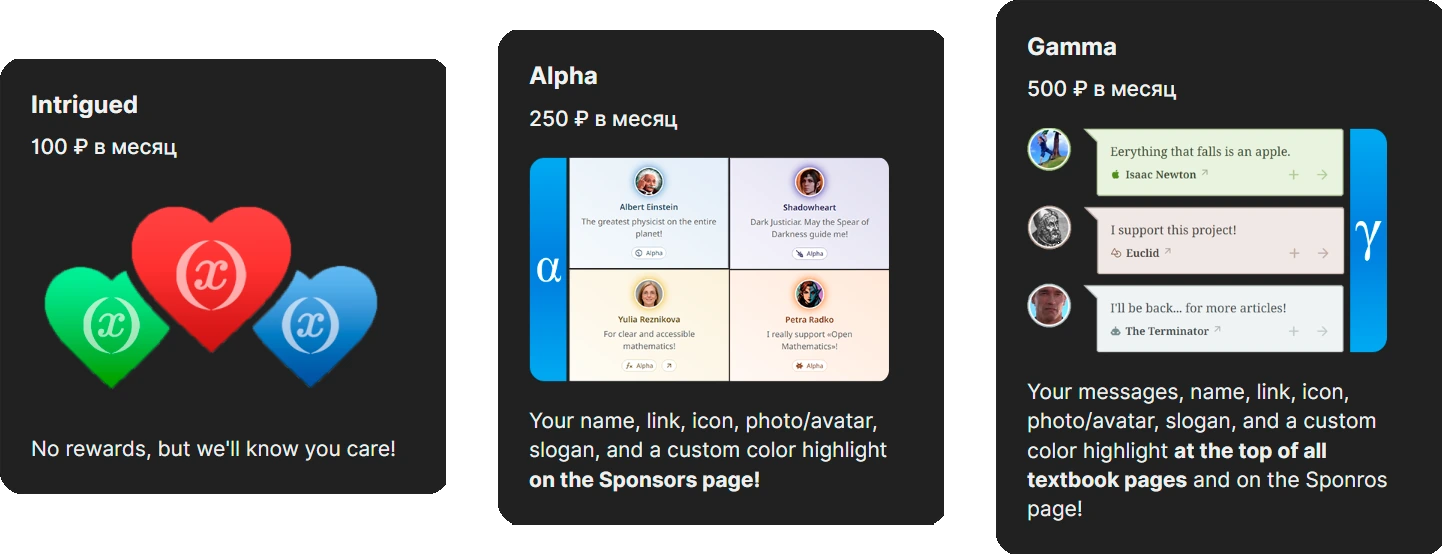
If you would like to, you can support the project financially. When setting up regular payments, your details (photo/avatar, icon, name, wishes) will be displayed on the sponsors page, as well as at the top of every page of the site materials!
Help make the best math content! 🤝
Who is in charge here?
“The Boss” is Peter Radko. I developed the engine of this site (and many of its previous iterations), and also wrote most of the materials. The project took more than seven years to reach its current form. For any questions, you can contact me via Telegram @gwynerva or by email the.gwynerva@gmail.com
For content questions, besides me, you can contact any “editor” whom you can find in the list of project authors.
How does it work?
The project runs on the universal educational site engine Erudit. With its help, you can create “Open Physics”, “Open Chemistry”, and any other modern educational projects. There is full support for cross-references with automatic dependency formation, beautiful blocks, diagrams, mathematical formulas, and other cool stuff. The project is open source. Anyone can use it for their own purposes!
The operating principle is very simple. All files are written in TypeScript TSX (a superset of JavaScript), then the Erudit engine processes, analyzes, and turns them into ready-made web pages. This is how the source code of this very page you are reading now looks. Everything is beautifully formatted and broken down by tags!