What is a Quadratic Equation?
Connections:
Statistics:
- Term2
- Important1
- Problem5
- Updated
Complicated square
We solve almost all elementary equations by simplifying them step by step until we get a simple equality of the form x = A or A = x (which is the same thing), where A is some number that is the solution to the equation. It might seem that now we are all-powerful and can solve any equation! Well, let’s check it out!
Equations with a nuance…
Applied
👀
Example
An ancient Greek king (they were called basileis) ordered a luxurious garden to be built with an area of 36 square meters. Also, one of its sides must be 5 meters longer than the other. What should be the length and width of the garden?
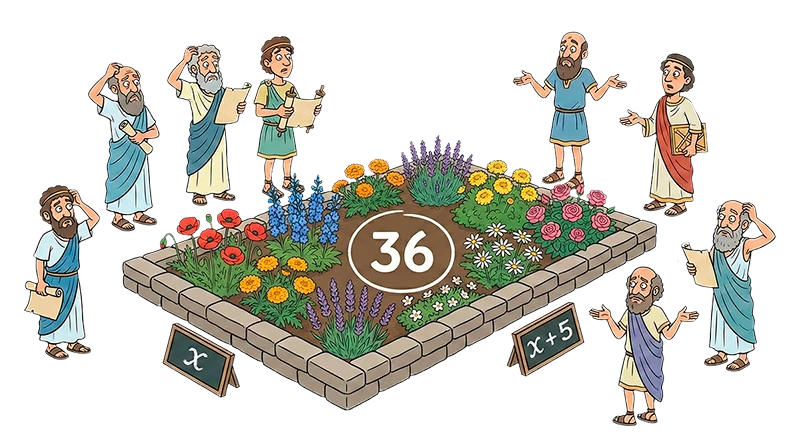
Ancient sages are confused…
As you can see, such equations appear regularly. This is not some unique case. Such equations, in which the unknown is raised to the second power, are found everywhere. It is not good when damn gardens, picture frames and simple motion problems can break our equations and lead us to a dead end! For now you just remember these bastards. In this topic we leave them unsolved, but we do deal with them later!
Let’s focus on ways to 100% identify such problematic equations.
Quadratic trinomial
To solve such equations, we must first understand what we are dealing with. It seems obvious to classify equations that have as quadratic. But, as always, the most obvious approach may not be the best one. This approach has serious drawbacks:
1
There may be no square, but the equation is still quadratic!
In the examples about the garden and the picture frame above, we have already seen that an equation that initially has no squares can turn out to be quadratic; squares appear after transformations.
2
There may be a square, but the equation is not quadratic!
Sometimes the existing is eliminated in the process of transformations and plays no role:
Our enemy is cunning and treacherous! Quadratic equations can be disguised, hiding their square, or they can have an explicit square and not be quadratic at all! But mathematicians are no fools either and were able to figure out a way to determine exactly which equations are quadratic and which are not.
As in any good detective story, first mathematicians analyzed all equations and identified a “modus operandi”, a general portrait that is characteristic of all quadratic equations. They quite simply called this portrait a quadratic trinomial.
Quadratic trinomial
Any polynomial written in the following “standard” form:
For example:
Why quadratic?
Because the maximum power of the variable in it is two, that is, “variable squared”.
Why trinomial?
Because it consists of three terms (monomials): , Bx and C. And even if there are fewer terms, as for example in , the missing term can be considered equal to zero: .
Why ?
Because if A = 0, multiplied by it becomes zero and disappears. And the polynomial is no longer quadratic! There is no “square”, that is, the second power, in it.
Quadratic equation
“Quadratic trinomial” is a general name for mathematical expressions of a certain type. They are sometimes used on their own, but now it is important that they help us formulate a solid and clear definition of quadratic equations.
Quadratic equation
The general form of a quadratic equation is any equation that has a quadratic trinomial on one side and zero on the other:
Any equation that has this general form or can be reduced to it by transformations without changing the roots is called a quadratic equation:
Power matters, not position
The vast majority of beginners get confused when determining the coefficients A, B and C in a quadratic equation. Coefficients are attached to the powers of x. But the positions they occupy do not matter!
1
Coefficient A always stands next to .
2
Coefficient B always stands next to x.
3
Coefficient C always stands alone. There are no variables next to it!
Consider the example . Remember that A is always before , so it is equal to 4. B is always before x, so it is equal to –2. –3 stands alone; this is the coefficient C.
Now we know the enemy by sight and understand that the coefficients depend not on the position in the equation, but on the power of x they accompany. Let’s practice determining whether equations are quadratic and finding their coefficients A, B and C.
Quadratic or not?
😀
Elementary
Check if the equation is quadratic or not. If the equation is quadratic, using the same action rule, bring it to the general form and find the values of its coefficients A, B and C.
Beginners and those who struggle with this topic regularly get confused and use the terms “quadratic trinomial” and “quadratic equation” as synonyms. Just in case, let’s clarify once again. A quadratic trinomial and a quadratic equation are NOT the same thing at all, but completely different mathematical objects! A quadratic trinomial is just a type of mathematical expression and often appears as a part of more complex expressions.
For example, there are three quadratic trinomials (colored) in the complex expression below:
Sometimes quadratic trinomials can occur in equations. And if there is a way to transform this equation to a form with only a quadratic trinomial on one side and zero on the other, then such an equation is called “quadratic”:
Why all the fuss?
Why exactly did we spend so much time defining quadratic trinomials, naming their coefficients, and doing other things? There are two reasons for this:
1
Now we can decide for certain which equations are quadratic and which are not.
2
We defined key terms that will be used to create formulas for solving quadratic equations and discovering their interesting and useful properties.